The story
Volubilis began as a town of the Berber kingdom of Mauretania, more than 2,200 years ago. Its rich farmland was perfect for olives and wheat. Around 40 CE, the Romans took over the region, and Volubilis grew into a busy Roman city at the far edge of the empire.
Wealthy families built big houses with courtyards and decorated their floors with mosaics. Some show Hercules performing his labors, dolphins leaping, and the god Bacchus. In 217 CE, the people built a triumphal arch to honor Emperor Caracalla.
Around 285 CE, Rome pulled its soldiers back, but people kept living here. Centuries later, a ruler named Idris I stayed here while starting a new Moroccan kingdom, before the capital moved to nearby Fes.
How it ended
Volubilis slowly emptied after Rome pulled back and trade routes changed. The great Lisbon earthquake of 1755 toppled many of its buildings, and people took its stones for new construction.
What life was like
Olive oil was Volubilis's big business. Archaeologists found dozens of olive presses in town. Families ate bread, olives and figs, went to public baths, and met friends in the forum. Merchants traded grain and oil. Some wild animals from the nearby hills, like lions, were sent to Rome for shows in arenas.
Wow facts
- Archaeologists have found dozens of olive oil presses inside the city.
- A bronze statue of a dog found here is one of Morocco's prized treasures.
- Building stone from Volubilis was later carried off to build a palace in the nearby city of Meknes.
Photos
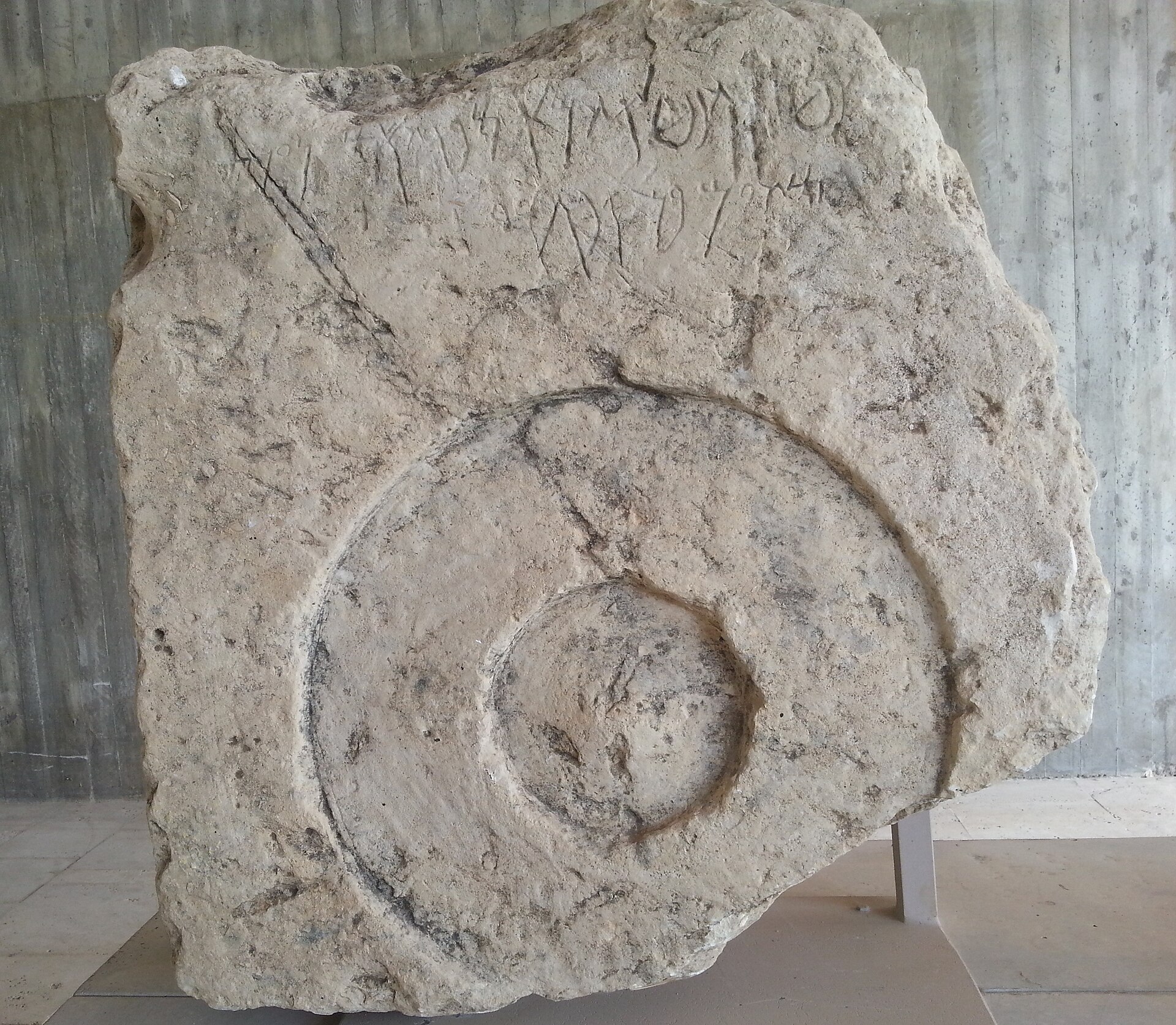 A Punic (Phoenician) inscription from Volubilis, with a double circle (a shield with an... Dorieo, CC BY-SA 3.0
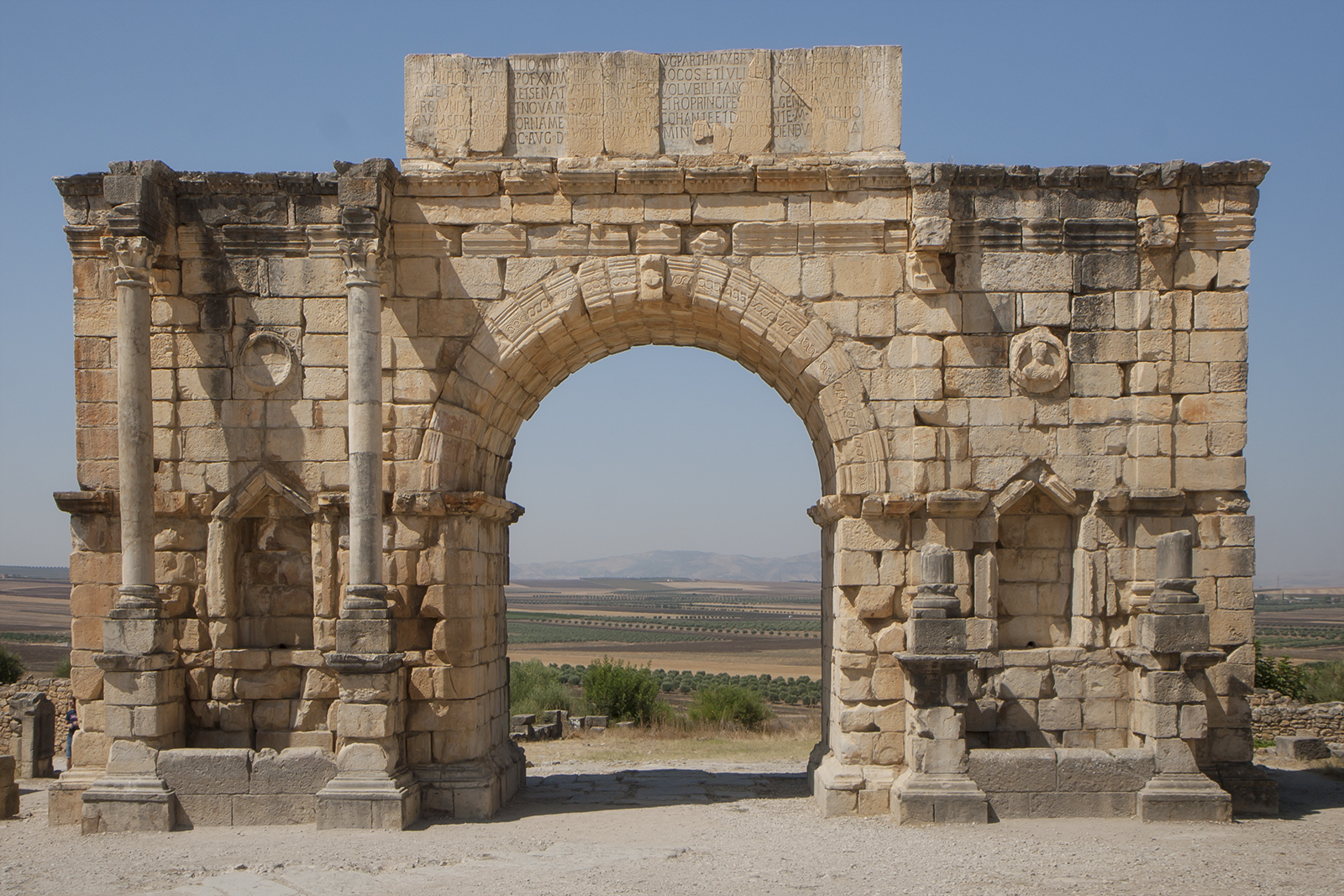 The triumphal arch built in honor of the emperor Caracalla. CarlOttersen, CC BY-SA 4.0
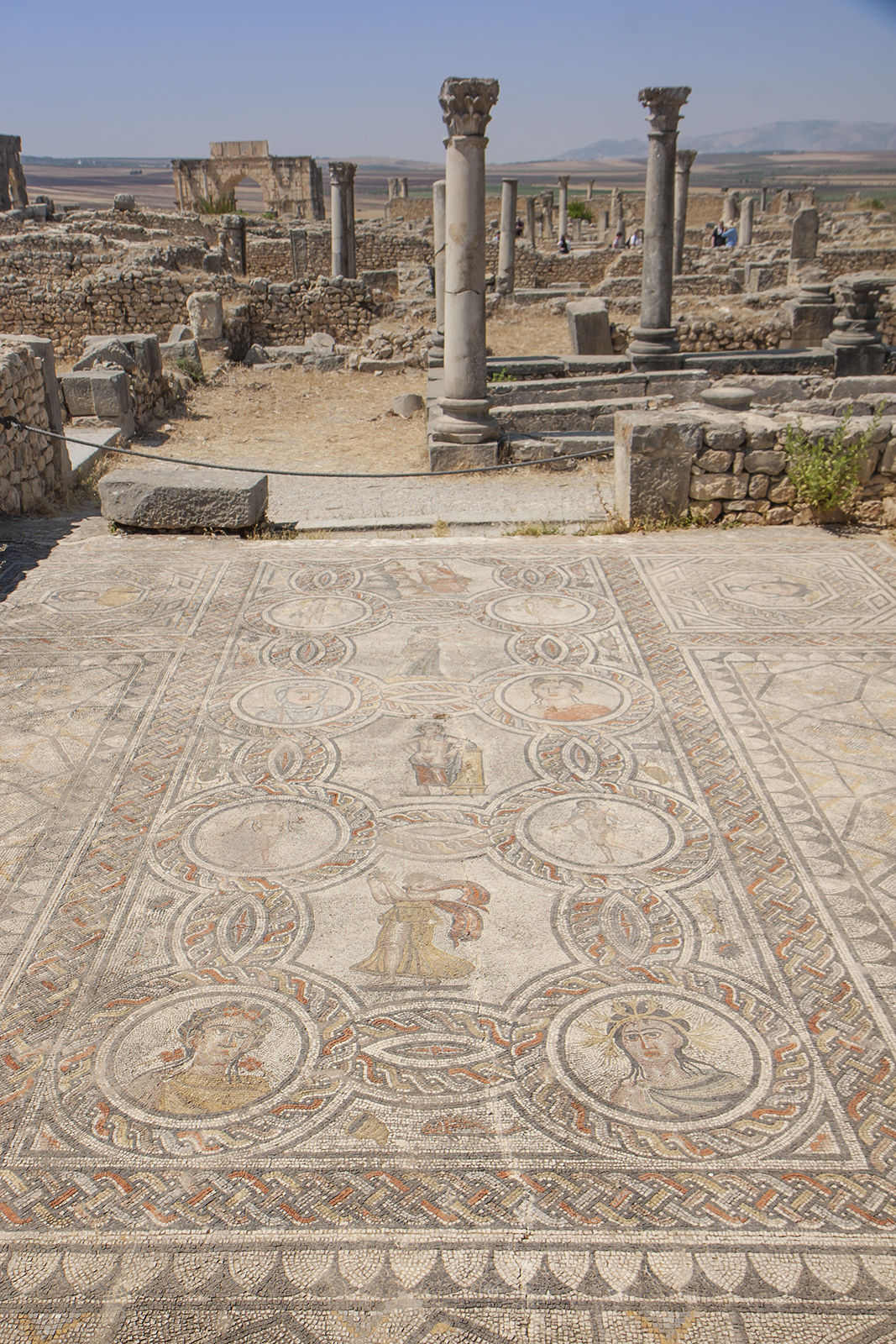 Many fine houses and public buildings in Volubilis, just as throughout the Roman Empire,... CarlOttersen, CC BY-SA 4.0
Relics and treasures
- Arch of Caracallaa triumphal arch from 217 CE, still standing at the site
- Labors of Hercules mosaica floor showing the hero's tasks, still in place at the site
- Bronze dog statuea Roman bronze found at Volubilis, in the Rabat Archaeological Museum
- Olive pressesstone presses for making oil, still at the site
How we know
French archaeologists began excavating in 1915, and Moroccan teams continue the work. Latin inscriptions name rulers and families. Coins, pottery and the olive presses show how people lived and traded.
What you would see today
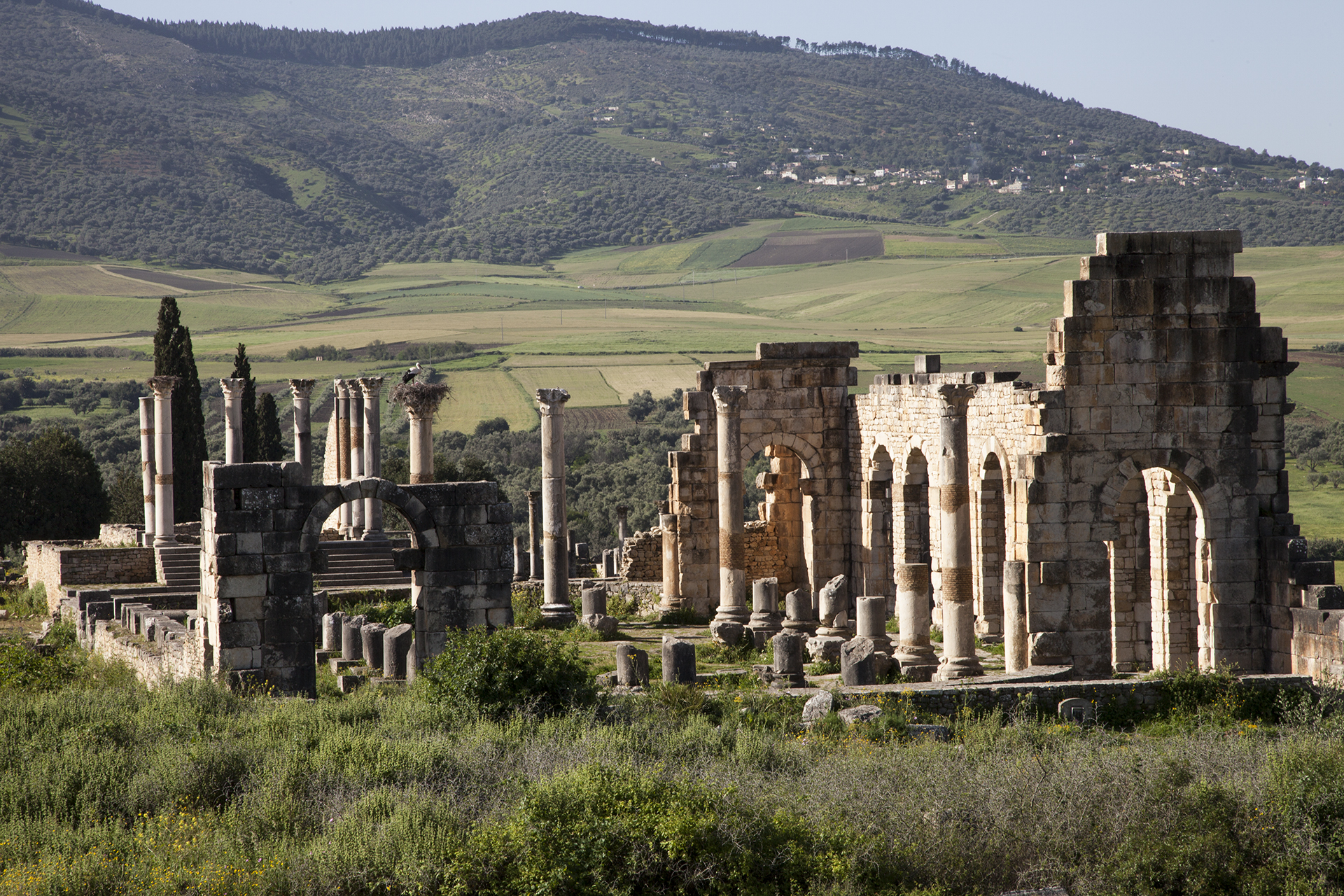
Visitors walk along the main street, stand under the arch of Caracalla, and look at mosaics still lying in the floors where they were made. Storks often nest on top of the old columns.
For teachers and classrooms
Suggested level: grades 3-5. Print this page as a lesson sheet with the story, vocabulary, discussion questions and a quiz with an answer key.
Key words
- mosaic
- a picture made from many tiny pieces of stone, glass or tile
- triumphal arch
- a large arch built to celebrate a ruler or victory
- frontier
- the far edge of a country or empire
Talk about it
- Why do you think people at the edge of an empire wanted to copy life in Rome?
- If you made a floor mosaic, what would it show?
Try this activity
- Draw a map of Volubilis as it looked at its busiest, and label three things people did there.
- Find Volubilis on the Ruinscape timeline, then pick another place from the same century and compare them.
- Use one link in Sources below to find a real object from this place. Describe what it is made of and what it tells us.
Quick quiz
What was Volubilis's most important product?
- Olive oil
- Gold
- Silk
- Rice
Show the answer
A. Dozens of olive presses have been found there.
In which country is Volubilis?
- Egypt
- Morocco
- Spain
- Italy
Show the answer
B. Volubilis is in Morocco, near Meknes.
Which emperor was honored by the city's arch?
- Augustus
- Nero
- Caracalla
- Hadrian
Show the answer
C. The arch was built in 217 CE for Caracalla.
Sources and further reading
Ruinscape lessons are written for students and checked against encyclopedia and museum records. Go to the sources: these links search real museum collections, the UNESCO list and research by archaeologists.
- Wikipedia articleEncyclopedia overview with its own references
- UNESCO World HeritageOfficial listing, if the site is protected
- Google Arts & CultureMuseum exhibits, virtual tours and close-up photos
- British Museum collectionReal objects, photos and catalog notes
- The Met collectionObjects and essays from the Metropolitan Museum of Art
- Smithsonian collectionsU.S. national museum records
- 3D models on SketchfabScans of sites and artifacts (check each license)
- Scholarly articlesResearch papers by archaeologists and historians
Read the full background
Volubilis (Latin pronunciation: [wɔˈɫuːbɪlɪs]; Arabic: وليلي, romanized: walīlī; Berber languages: ⵡⵍⵉⵍⵉ, romanized: wlili) is a partly excavated Berber-Roman city in Morocco, situated near the city of Meknes, that may have been the capital of the Kingdom of Mauretania, at least from the time of King Juba II. Before Volubilis, the capital of the kingdom may have been at Gilda.
Built in a fertile agricultural area, it developed from the 3rd century BC onward as a Berber, then proto-Carthaginian, settlement before being the capital of the kingdom of Mauretania. It grew rapidly under Roman rule from the 1st century AD onward and expanded to cover about 42 hectares (100 acres) with a 2.6 km (1.6 mi) circuit of walls. The city gained a number of major public buildings in the 2nd century, including a basilica, temple and triumphal arch. Its prosperity, which was derived principally from olive growing, prompted the construction of many fine town-houses with large mosaic floors.
The city fell to local tribes around 285 and was never retaken by Rome because of its remoteness and indefensibility on the south-western border of the Roman Empire. It continued to be inhabited for at least another 700 years, first as a Latinised Christian community, then as an early Islamic settlement. In the late 8th century it became the seat of Idris ibn Abdallah, the founder of the Idrisid dynasty of Morocco. By the 11th century Volubilis had been abandoned after the seat of power was relocated to Fes. Much of the local population was transferred to the new town of Moulay Idriss Zerhoun, about 5 km (3.1 mi) from Volubilis.
The ruins remained substantially intact until they were devastated by an earthquake in 1755 and subsequently looted by Moroccan rulers seeking stone for building Meknes. It was not until the latter part of the 19th century that the site was definitively identified as that of the ancient city of Volubilis. During and after the period of French rule over Morocco, about half of the site was excavated, revealing many fine mosaics, and some of the more prominent public buildings and high-status houses were restored or reconstructed. Today it is a UNESCO World Heritage Site, listed as "an exceptionally well preserved example of a large Roman colonial town on the fringes of the Empire".
Background text from Wikipedia, available under CC BY-SA 4.0.
Last updated: October 2026. How we make Ruinscape.