The story
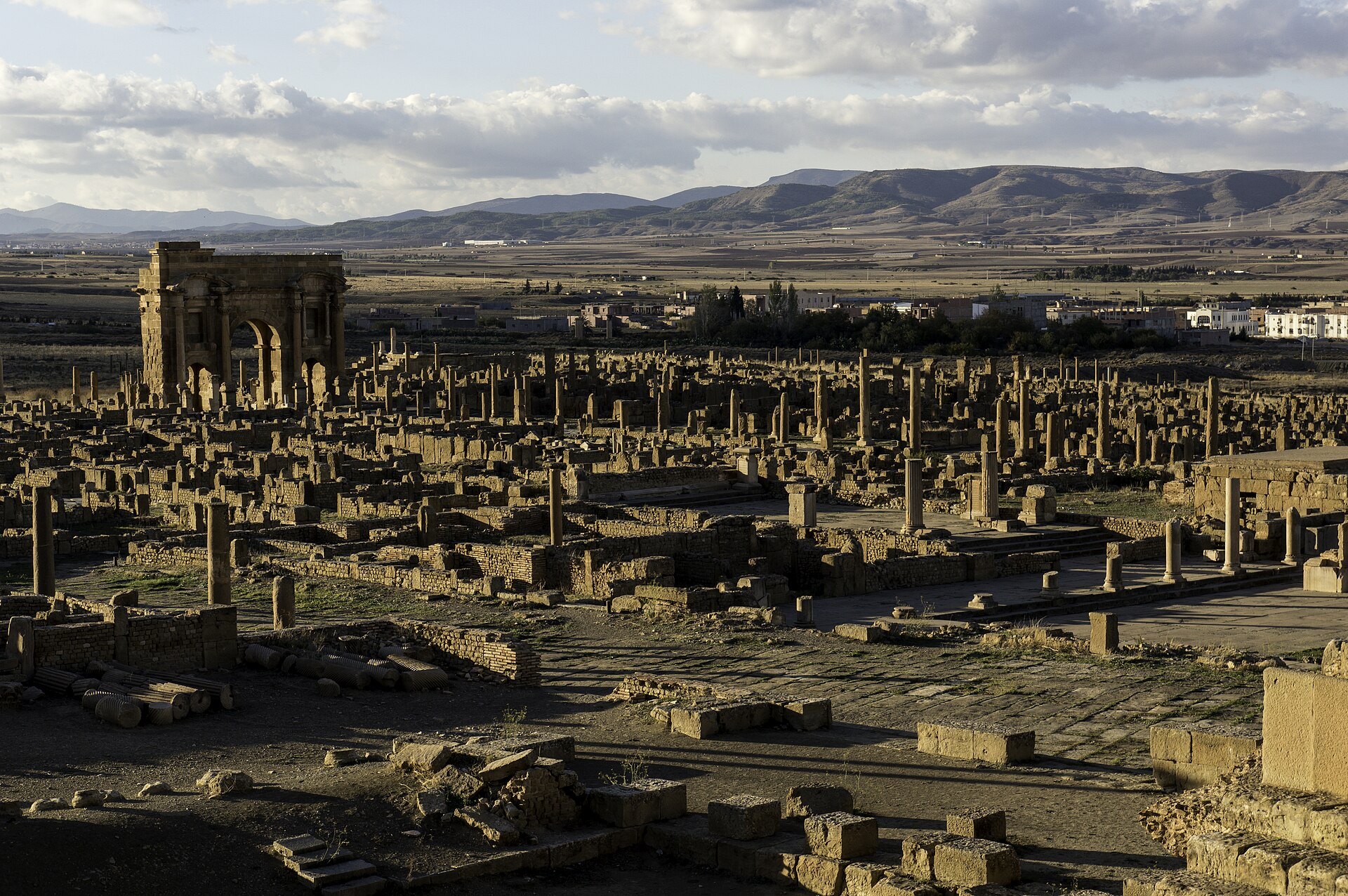
Around 100 CE, Roman Emperor Trajan founded Timgad as a home for retired soldiers. Planners laid it out like a Roman army camp, with two main streets crossing in the middle and a grid of square blocks.
The town grew quickly, spreading beyond its first walls. It had a forum, a theater for about 3,500 people, more than a dozen public baths, a market, and even a public library, which was rare.
Later, Timgad became an important Christian center. In the 400s, Vandals and raiders from the mountains attacked. The Byzantines built a fort here, but by the 600s the city was emptied. Sand from the Sahara blew in and covered it.
How it ended
Raids in the 400s weakened Timgad, and after the Byzantine period it was abandoned by the 600s. Desert sand slowly buried it, which preserved its streets until they were dug out in the 1880s.
What life was like
Retired soldiers farmed nearby land and raised families in town. People shopped at the market, met in the forum and relaxed at the baths. One famous carving in the forum says, roughly: to hunt, to bathe, to play and to laugh, that is to live. Kids played games on boards scratched into the pavement.
Wow facts
- Timgad had a public library, which was rare for a Roman town.
- Game boards are still scratched into the forum's stone floor.
- Sand buried the city so well that it is sometimes called the Pompeii of Africa.
Photos
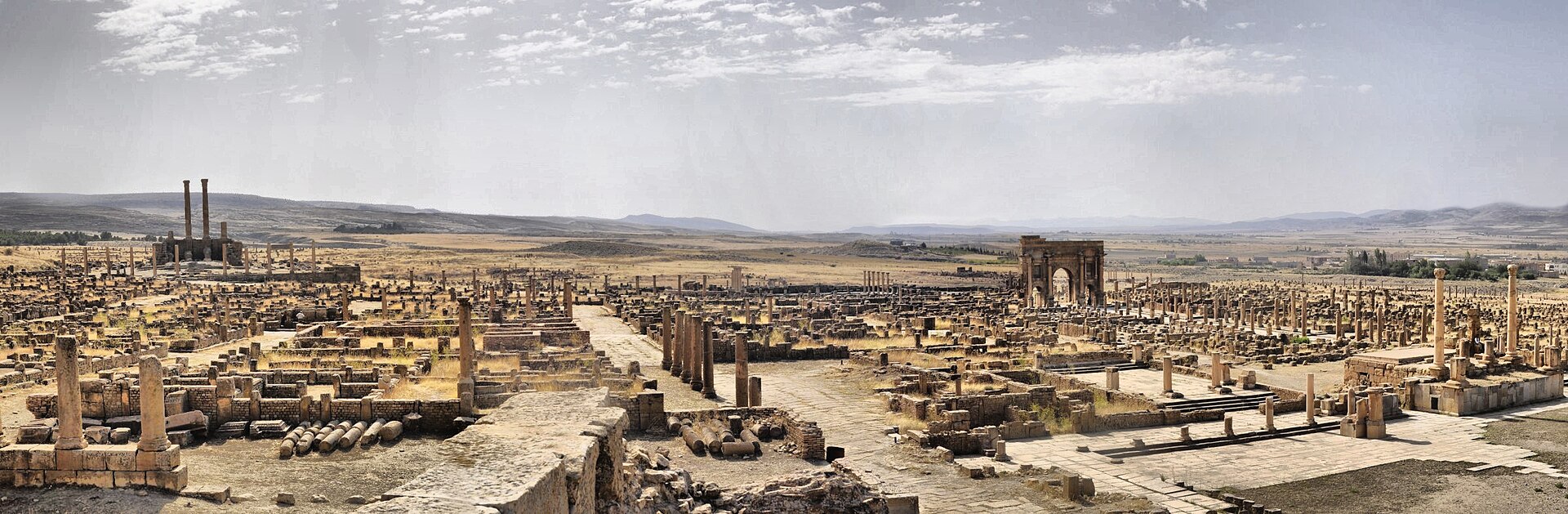 Territoires et monuments de l'antique Thamugadi., Hamza-sia, CC BY-SA 3.0
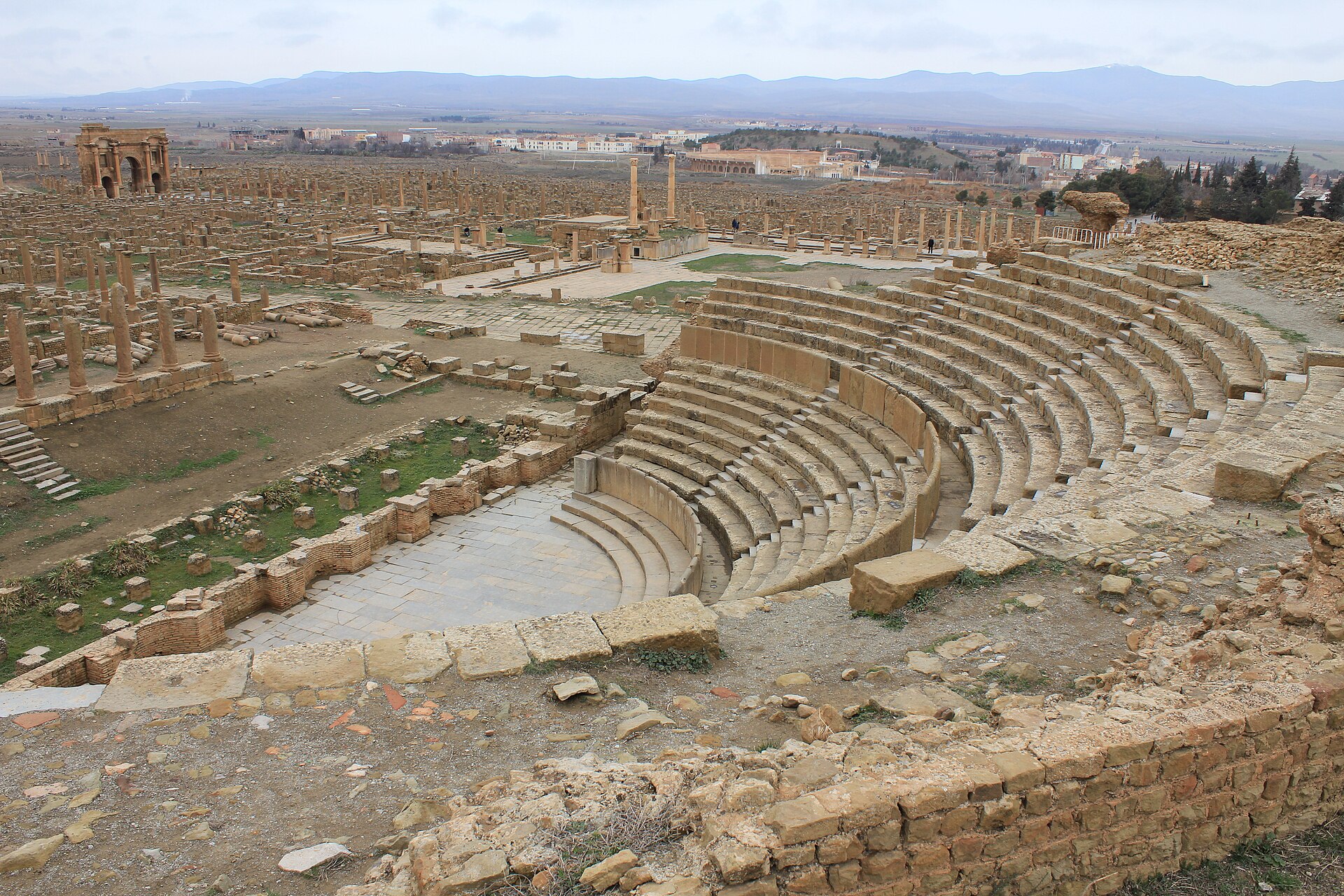 Timgad, Algeria Xiaotong Gao, CC BY-SA 3.0
Relics and treasures
- Trajan's Archthe city's triple arch, still standing at the site
- Forum inscription about the good lifea carved Latin saying, still at the site
- Timgad mosaicscolorful floors from houses and baths, in the Timgad Museum
- The librarythe ruins of the town's public library, still at the site
How we know
French archaeologists started uncovering Timgad in 1881, and Algerian teams continue to study it. Inscriptions name its founder, Trajan, and the year it started. Aerial photos show its almost perfect grid.
What you would see today
Visitors walk Timgad's grid of streets, pass under Trajan's Arch, sit in the theater, and look for the famous to hunt, to bathe, to play, to laugh inscription. A museum on site holds mosaics found in the city.
For teachers and classrooms
Suggested level: grades 3-5. Print this page as a lesson sheet with the story, vocabulary, discussion questions and a quiz with an answer key.
Key words
- grid
- a pattern of straight lines crossing to make squares
- veteran
- a person who has served in the military
- forum
- the main public square of a Roman town
Talk about it
- Would you rather live in a town with a grid or with winding streets? Why?
- The carving says hunting, bathing, playing and laughing is living. What would you put on your list?
Try this activity
- Draw a map of Timgad as it looked at its busiest, and label three things people did there.
- Find Timgad on the Ruinscape timeline, then pick another place from the same century and compare them.
- Use one link in Sources below to find a real object from this place. Describe what it is made of and what it tells us.
Quick quiz
Which emperor founded Timgad?
- Trajan
- Julius Caesar
- Constantine
- Nero
Show the answer
A. Trajan founded it around 100 CE.
Who were Timgad's first settlers?
- Retired soldiers
- Pirates
- Pharaohs
- Vikings
Show the answer
A. It was built as a home for retired Roman soldiers.
What buried Timgad?
- Volcanic ash
- Sahara sand
- Ice
- A flood
Show the answer
B. Desert sand blew in and covered the city.
Sources and further reading
Ruinscape lessons are written for students and checked against encyclopedia and museum records. Go to the sources: these links search real museum collections, the UNESCO list and research by archaeologists.
- Wikipedia articleEncyclopedia overview with its own references
- UNESCO World HeritageOfficial listing, if the site is protected
- Google Arts & CultureMuseum exhibits, virtual tours and close-up photos
- British Museum collectionReal objects, photos and catalog notes
- The Met collectionObjects and essays from the Metropolitan Museum of Art
- Smithsonian collectionsU.S. national museum records
- 3D models on SketchfabScans of sites and artifacts (check each license)
- Scholarly articlesResearch papers by archaeologists and historians
Read the full background
Timgad or Thamugadi (colonia Marciana Traiana Thamugadi in latin, Arabic: تيمقاد, romanized: Tīmqād,) , nicknamed the «Pompeii of north africa» was a Roman city in the Aurès Mountains of Algeria. It was founded by the Roman Emperor Trajan around 100 CE. The full name of the city was Colonia Marciana Ulpia Traiana Thamugadi. Emperor Trajan named the city in commemoration of his mother Marcia, eldest sister Ulpia Marciana, and father Marcus Ulpius Traianus.
Timgad is Located in modern-day Algeria, about 35 km (22 mi) east of the city of Batna.
The ruins are noteworthy for representing one of the best extant examples of the grid plan as used in Roman town planning.
In 1982, UNESCO inscribed Timgad as a World Heritage Site.
Background text from Wikipedia, available under CC BY-SA 4.0.
Last updated: October 2026. How we make Ruinscape.