The story
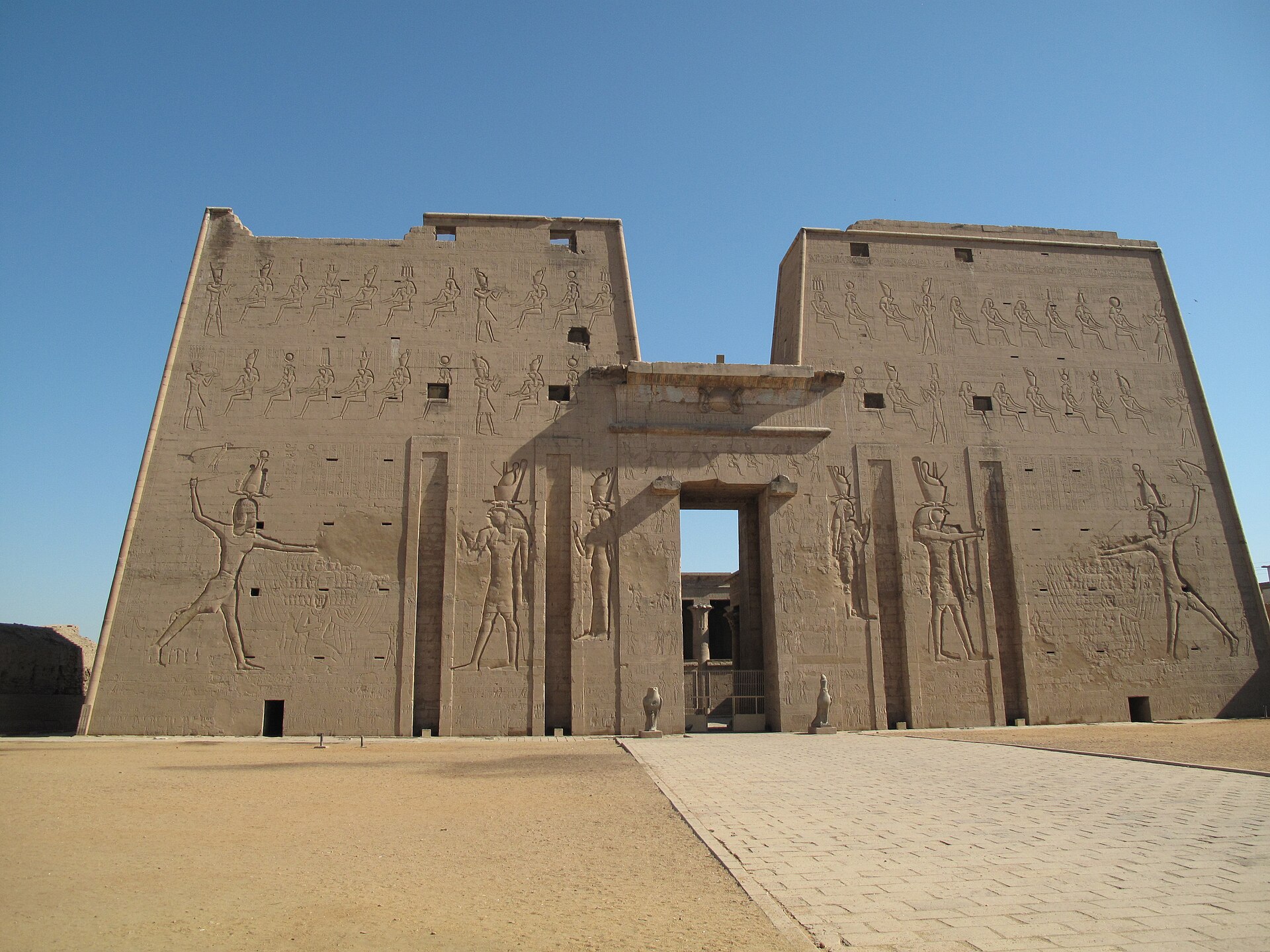
The Temple of Edfu was built for Horus, the falcon-headed sky god and protector of Egypt's kings. Work started in 237 BCE and took about 180 years. By then, Egypt was ruled by the Ptolemies, a Greek family who came to power after Alexander the Great. They built in the old Egyptian style to win the people's support.
The walls are covered with carvings. One famous story shows Horus battling his uncle Seth, who sometimes appears as a hippopotamus. Other carvings explain how the temple was built and how festivals were run, almost like an instruction book in stone.
Each year, a statue of the goddess Hathor traveled by boat from her temple at Dendera to visit Horus at Edfu. Their festival lasted about two weeks, with music, feasting and crowds lining the river.
How it ended
The temple stopped being used after Roman emperors banned the old religion around 391 CE. Over the centuries, sand and Nile mud filled it, and a village grew on its roof. That covering actually protected it until it was dug out in the 1800s.
What life was like
Only priests could go deep inside the temple, where the statue of Horus lived in a dark granite shrine. They washed it, dressed it and offered it food each morning. Ordinary people gathered in the outer courtyard or watched festival parades. Farmers nearby grew wheat and flax and paid part of their harvest to the temple. Scribes kept records, and craftsmen painted the carvings in bright colors.
Wow facts
- The temple's great gateway, called a pylon, is about 36 meters tall.
- Sand and mud once buried the temple almost to its roof, and houses were built on top of it.
- A live falcon may have been chosen each year to stand for Horus.
Photos
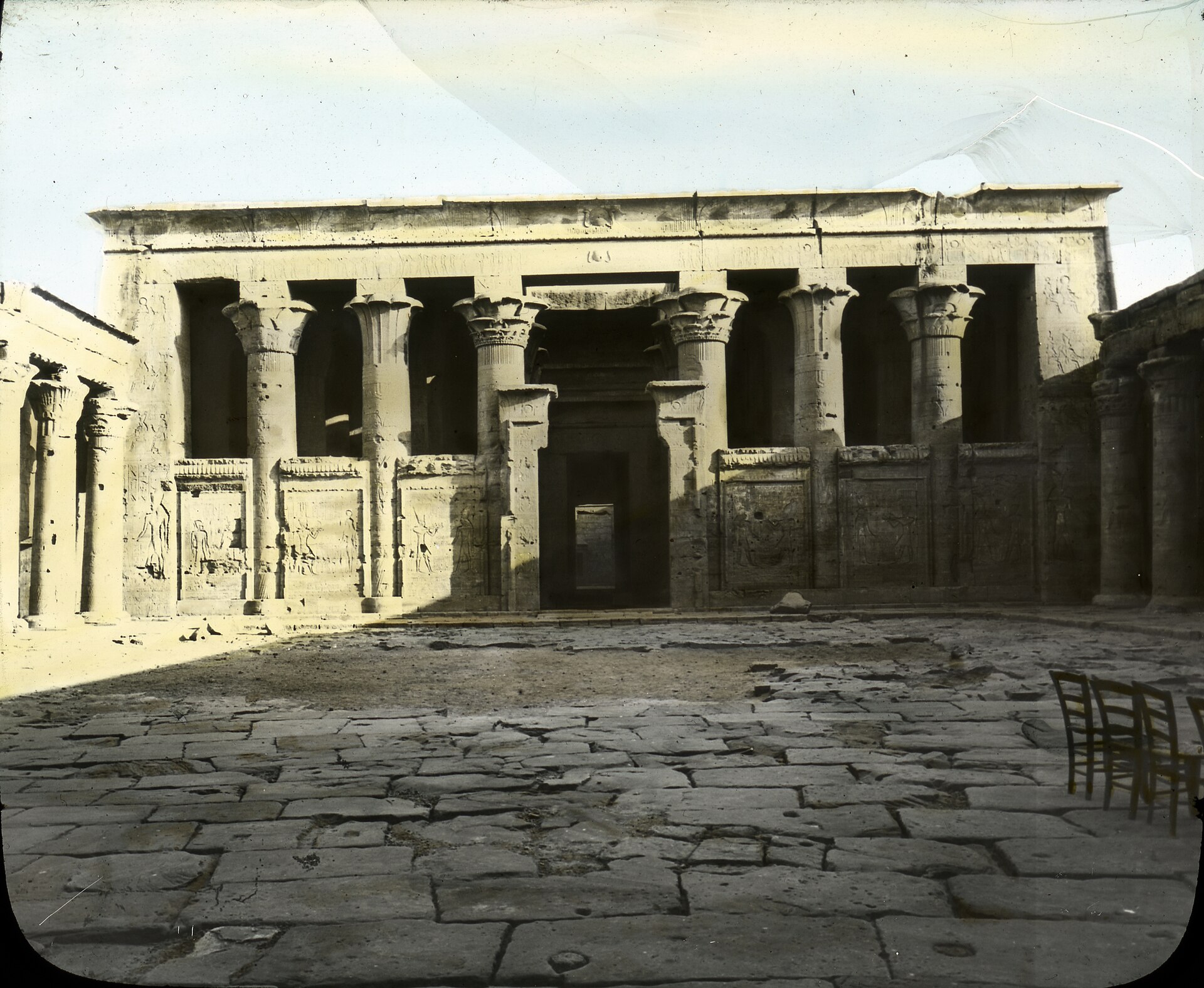 Lantern Slide Collection: Views, Objects: Egypt. Edfu [selected images]. View 03: Egypt... William Henry Goodyear, Public domain
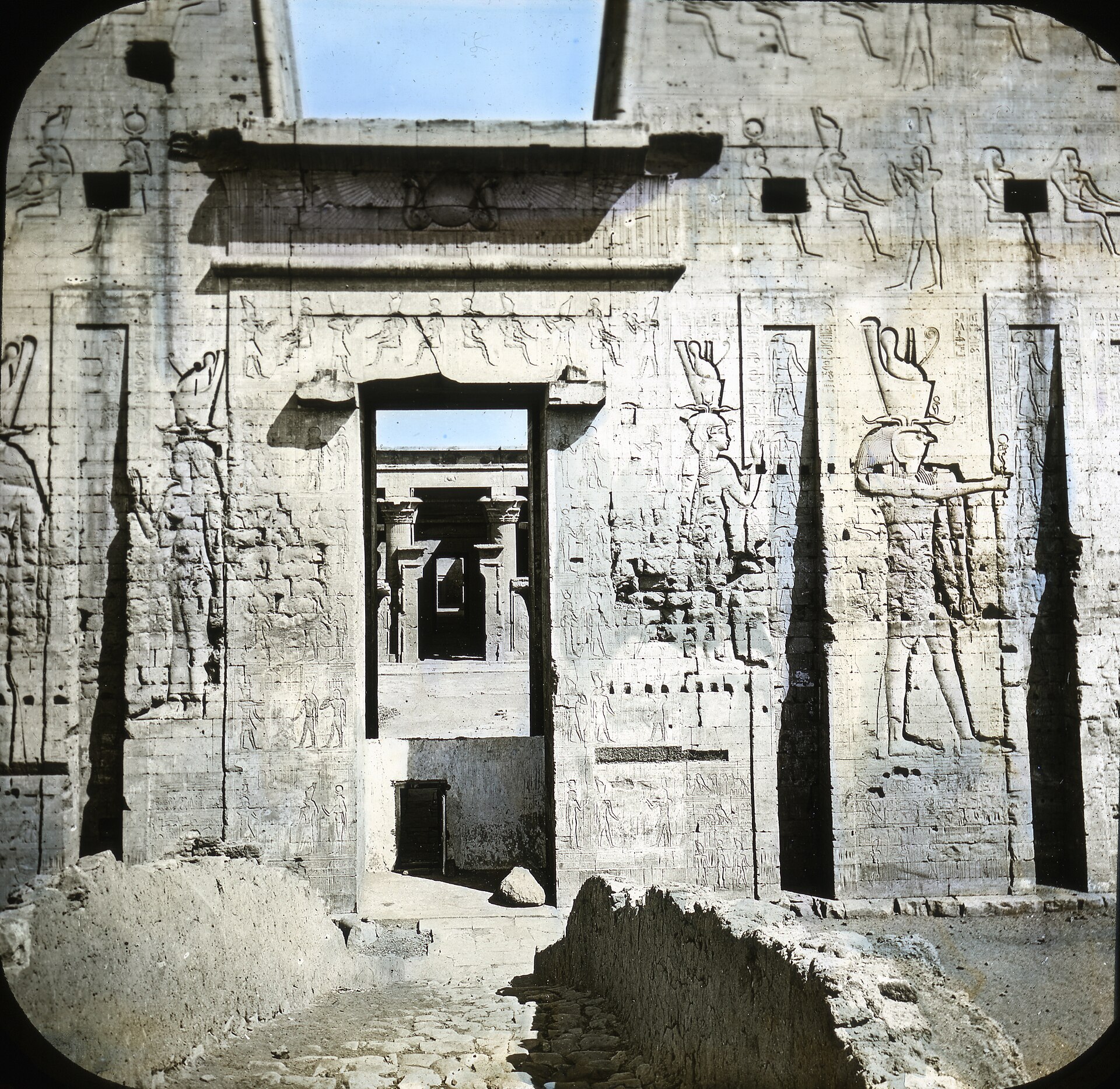 Lantern Slide Collection: Views, Objects: Egypt. Edfu [selected images]. View 02: Egypt... William Henry Goodyear, Public domain
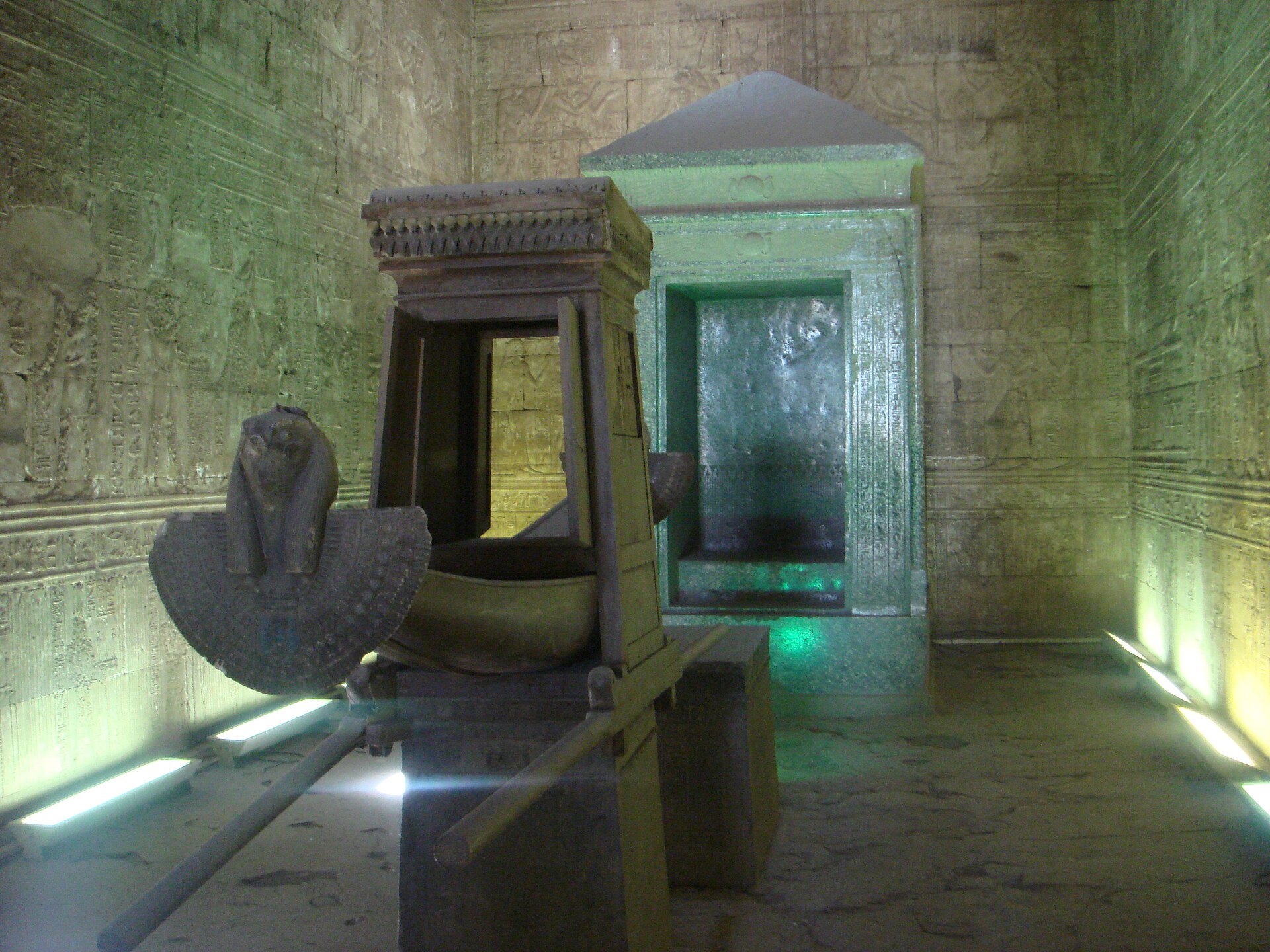 The inner sanctuary in the centre of the Temple of Edfu at Edfu, Egypt. timsdad, CC BY-SA 3.0
Relics and treasures
- Granite falcon statuestwo statues of Horus guarding the entrance, still at the site
- Naos of Horusthe polished granite shrine in the temple's inner room, still at the site
- Horus and Seth reliefslong carved battle scenes on the outer walls, still at the site
- Building textscarvings that describe the temple's construction, still on its walls
How we know
French archaeologist Auguste Mariette cleared the sand and houses from the temple in the 1860s. Scholars have since copied and translated its many inscriptions. Because the texts name rulers and dates, we know when each part was built.
What you would see today
Visitors walk through the huge pylon, across the courtyard and into dim halls of columns. They can see the dark granite shrine where Horus's statue once stood and read the battle of Horus and Seth along the outer walls. Many river cruises stop here.
For teachers and classrooms
Suggested level: grades 3-5. Print this page as a lesson sheet with the story, vocabulary, discussion questions and a quiz with an answer key.
Key words
- pylon
- a huge gateway with two tall towers at the front of an Egyptian temple
- relief
- a carving that stands out from a flat wall
- shrine
- a special place or box holding something holy
Talk about it
- How could being buried in sand help protect a building?
- Why might Greek rulers build temples in the Egyptian style?
Try this activity
- Draw a map of Temple of Edfu as it looked at its busiest, and label three things people did there.
- Find Temple of Edfu on the Ruinscape timeline, then pick another place from the same century and compare them.
- Use one link in Sources below to find a real object from this place. Describe what it is made of and what it tells us.
Quick quiz
Which god was the Temple of Edfu built for?
- Sobek
- Horus
- Osiris
- Amun
Show the answer
B. Edfu was built for Horus, the falcon god.
Who ruled Egypt when the temple was built?
- The Ptolemies
- The Romans only
- The Inca
- The Assyrians
Show the answer
A. The Ptolemies, a Greek family, ruled Egypt then.
What protected the temple for centuries?
- A glass roof
- Being buried in sand and mud
- A moat
- Ice
Show the answer
B. Sand and silt filled it and kept it safe until it was dug out.
Sources and further reading
Ruinscape lessons are written for students and checked against encyclopedia and museum records. Go to the sources: these links search real museum collections, the UNESCO list and research by archaeologists.
- Wikipedia articleEncyclopedia overview with its own references
- UNESCO World HeritageOfficial listing, if the site is protected
- Google Arts & CultureMuseum exhibits, virtual tours and close-up photos
- British Museum collectionReal objects, photos and catalog notes
- The Met collectionObjects and essays from the Metropolitan Museum of Art
- Smithsonian collectionsU.S. national museum records
- 3D models on SketchfabScans of sites and artifacts (check each license)
- Scholarly articlesResearch papers by archaeologists and historians
Read the full background
The Temple of Edfu is an Egyptian temple located on the west bank of the Nile in Edfu, Upper Egypt. The city was known in the Hellenistic period in Koine Greek as Ἀπόλλωνος πόλις and in Latin as Apollonopolis Magna, after the chief god Horus, who was identified as Apollo under the interpretatio graeca. It is one of the best preserved shrines in Egypt. The temple was built in the Ptolemaic Kingdom between 237 and 57 BC. The inscriptions on its walls provide important information on language, myth and religion during the Hellenistic period in Egypt. In particular, the Temple's inscribed building texts "provide details of its construction, and also preserve information about the mythical interpretation of this and all other temples as the Island of Creation." There are also "important scenes and inscriptions of the Sacred Drama which related the age-old conflict between Horus and Seth." They are translated by the Edfu-Project.
Background text from Wikipedia, available under CC BY-SA 4.0.
Last updated: October 2026. How we make Ruinscape.