The story
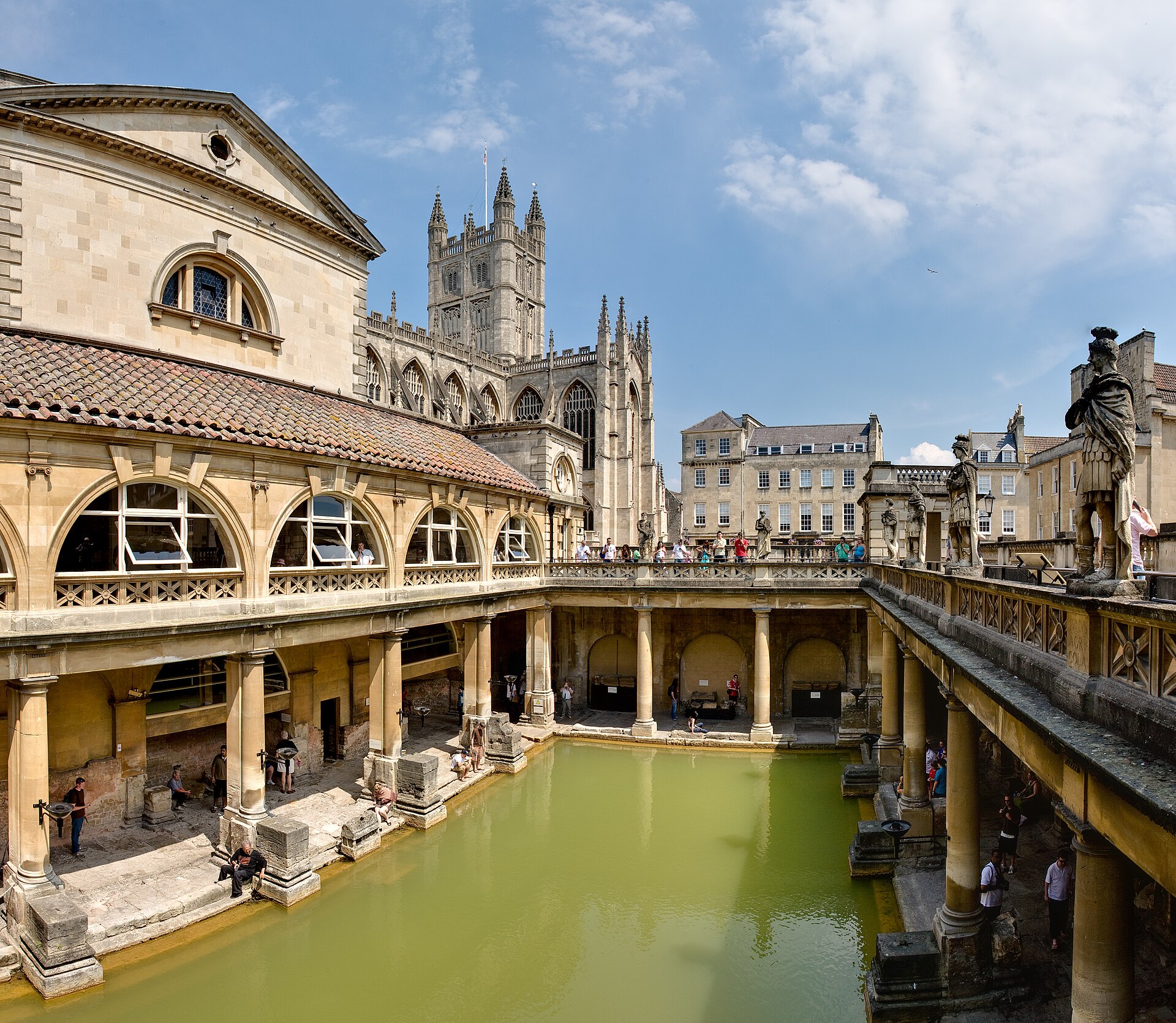
Bath has the only natural hot springs in Britain. Long before the Romans, the Celtic people worshiped a goddess named Sulis here. After the Romans arrived in 43 CE, they built a temple and grand bathhouse around the spring. They named the town Aquae Sulis, the waters of Sulis.
The Romans connected Sulis with their own goddess Minerva. Her temple had a gilded bronze statue, and a carved stone face, possibly a sea god or a gorgon, glared down from the temple's front.
Visitors bathed in warm pools, steam rooms and cold plunges. Many threw offerings into the spring, including coins and more than 100 curse tablets. These thin sheets of lead asked the goddess to punish people who stole clothes, rings or money.
How it ended
After Rome left Britain around 410 CE, the baths were not looked after. Silt from flooding and collapsing roofs covered them. They lay hidden for centuries until builders and archaeologists uncovered them.
What life was like
People came to Aquae Sulis to bathe, relax, pray and get well. Bathing was social, a place to chat, do business and exercise. Priests looked after the temple. Soldiers and travelers from across the empire visited. Lead pipes, which the Romans called plumbum, carried water around the baths.
Wow facts
- About 1 million liters of hot water rise from the spring every day.
- More than 100 curse tablets were found, one asking for punishment for whoever stole a cloak.
- The word plumbing comes from the Latin word for lead, plumbum.
Photos
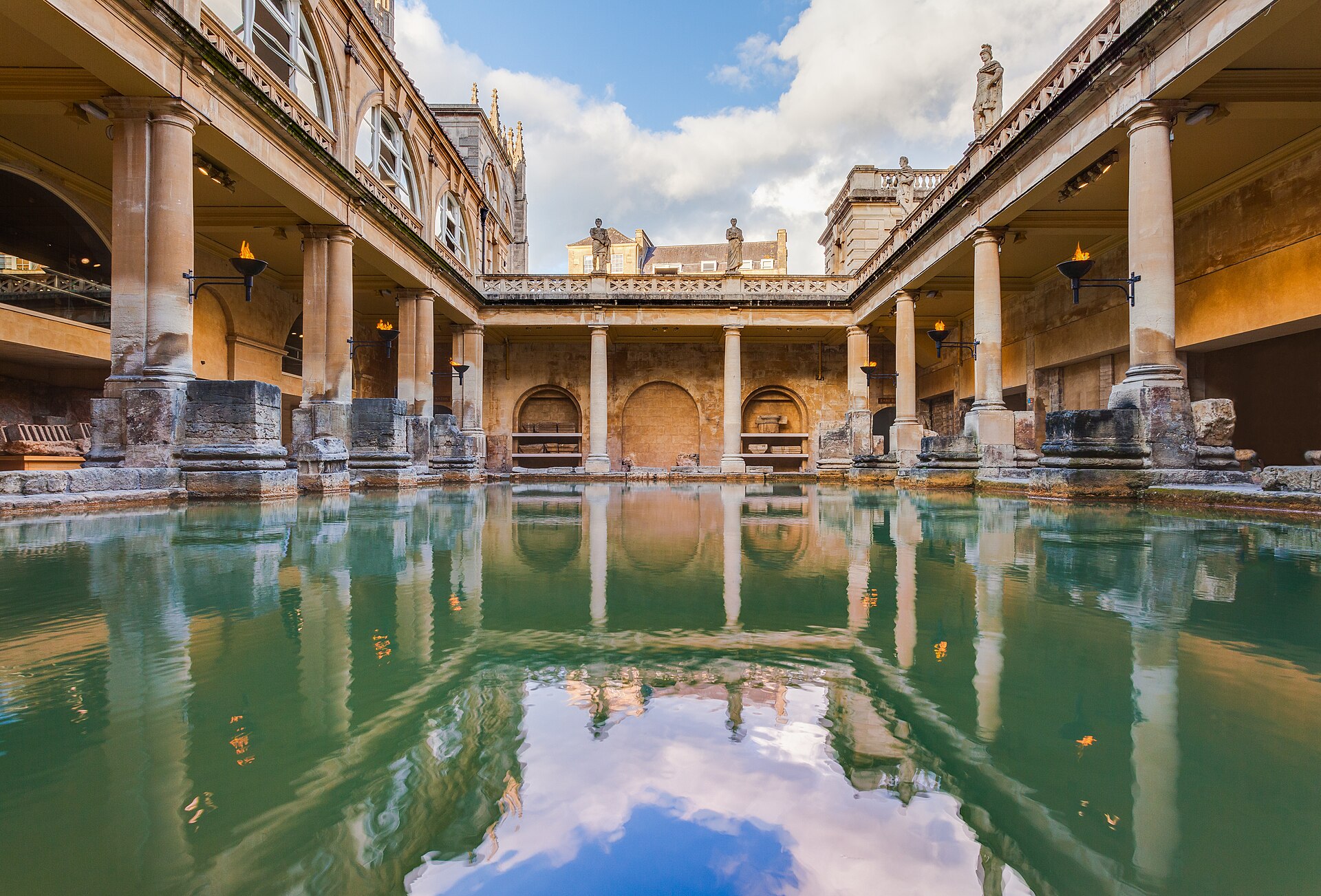 View of the Great Bath, part of the Roman Baths complex, a site of historical interest... Diego Delso, CC BY-SA 4.0
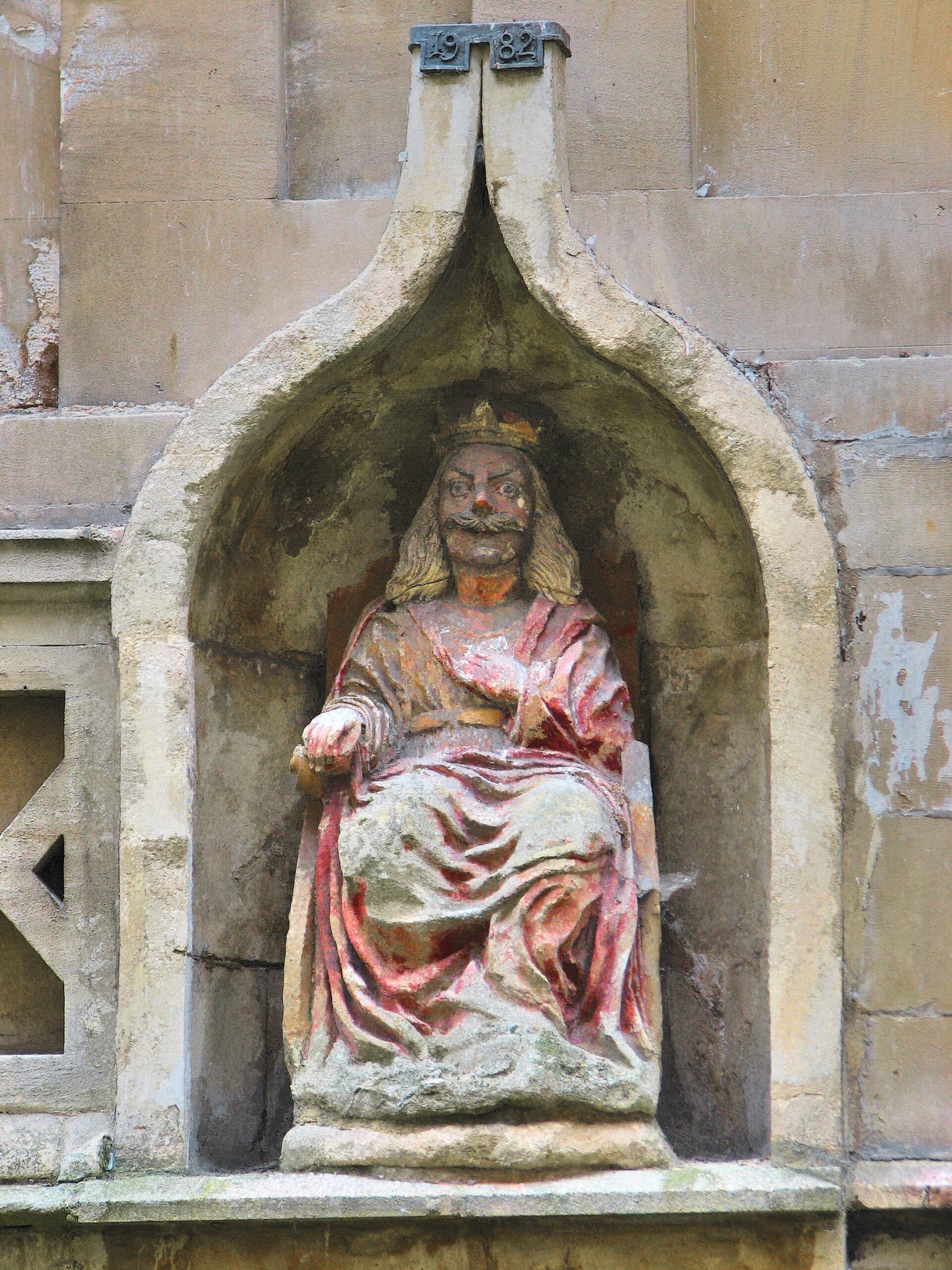 The statue of king Bladud at the Roman Baths, Bath, England. Smalljim, CC BY-SA 3.0
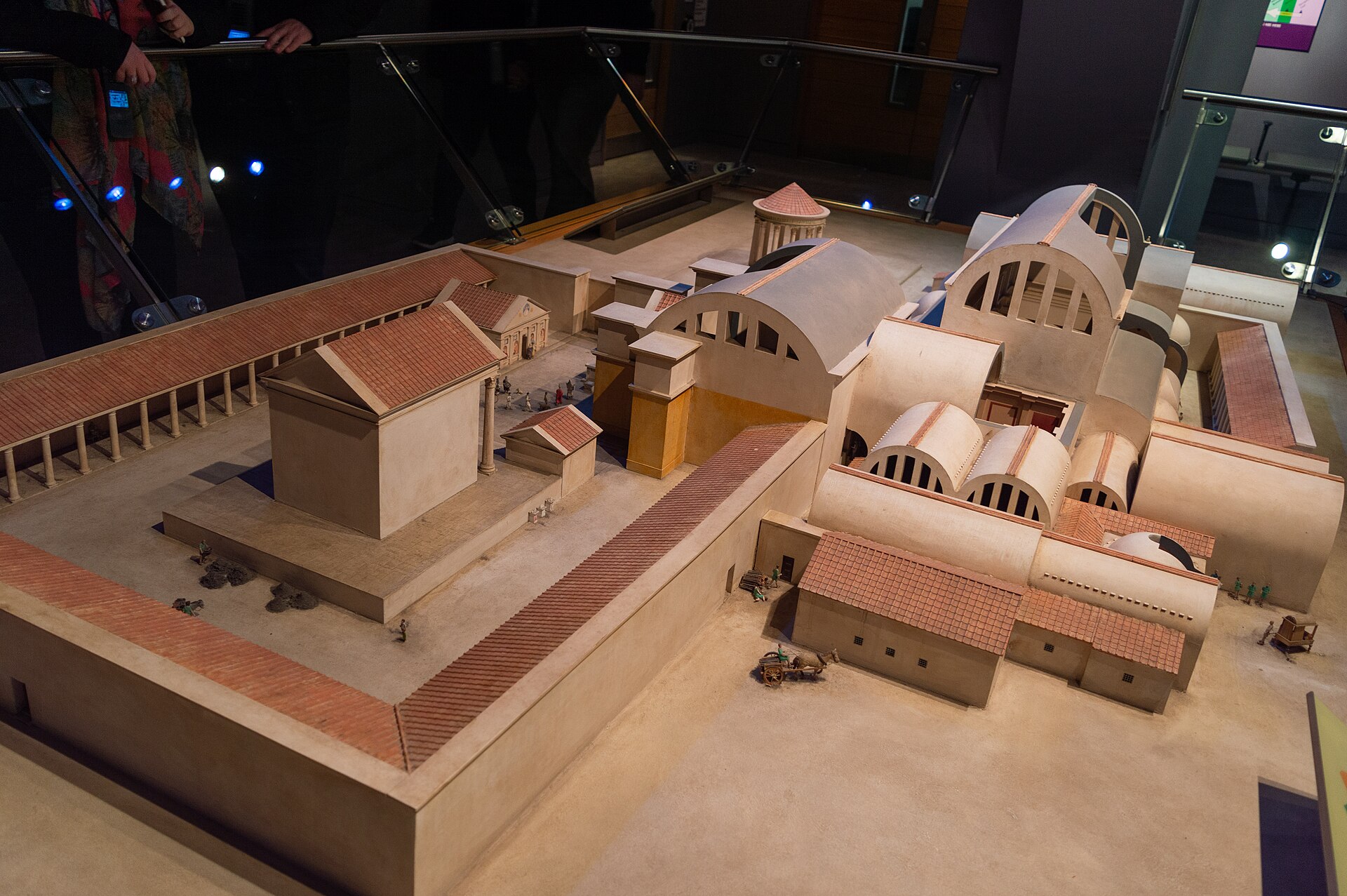 Maquette of the Roman Baths during the Roman age. Tristan Surtel, CC BY-SA 4.0
Relics and treasures
- Gilded head of Minervathe bronze head of the temple statue, in the Roman Baths museum
- Curse tabletslead sheets with messages to the goddess, in the Roman Baths museum
- Temple pediment facethe carved stone face from the temple front, in the Roman Baths museum
- The Great Baththe large Roman pool, still filled with spring water at the site
How we know
Parts of the temple were found in 1727 and 1790, and big excavations followed in the 1800s and later. The curse tablets were translated by experts. Coins and inscriptions show who visited.
What you would see today
Visitors walk around the Great Bath, see the steaming spring, and explore a museum with the gilded head of Minerva and the curse tablets. Nearby, a modern spa lets people bathe in the hot spring water.
For teachers and classrooms
Suggested level: grades 3-5. Print this page as a lesson sheet with the story, vocabulary, discussion questions and a quiz with an answer key.
Key words
- hot spring
- a place where warm water flows naturally out of the ground
- curse tablet
- a sheet of metal with a written wish for something bad to happen to someone
- offering
- a gift given to a god
Talk about it
- If you could write a message to throw into a wishing well, what would it say?
- How is a Roman bath like a modern swimming pool or gym?
Try this activity
- Draw a map of Roman Baths of Bath as it looked at its busiest, and label three things people did there.
- Find Roman Baths of Bath on the Ruinscape timeline, then pick another place from the same century and compare them.
- Use one link in Sources below to find a real object from this place. Describe what it is made of and what it tells us.
Quick quiz
Which goddess was linked to Bath's spring?
- Sulis Minerva
- Isis
- Freya
- Hera
Show the answer
A. Romans combined Celtic Sulis with their goddess Minerva.
What were curse tablets made of?
- Lead
- Paper
- Wood
- Glass
Show the answer
A. They were thin sheets of lead.
What is special about Bath's water?
- It is naturally hot
- It is salty
- It is frozen
- It is purple
Show the answer
A. Bath has Britain's only natural hot springs.
Sources and further reading
Ruinscape lessons are written for students and checked against encyclopedia and museum records. Go to the sources: these links search real museum collections, the UNESCO list and research by archaeologists.
- Wikipedia articleEncyclopedia overview with its own references
- UNESCO World HeritageOfficial listing, if the site is protected
- Google Arts & CultureMuseum exhibits, virtual tours and close-up photos
- British Museum collectionReal objects, photos and catalog notes
- The Met collectionObjects and essays from the Metropolitan Museum of Art
- Smithsonian collectionsU.S. national museum records
- 3D models on SketchfabScans of sites and artifacts (check each license)
- Scholarly articlesResearch papers by archaeologists and historians
Read the full background
The Roman Baths are well-preserved thermae in the city of Bath, Somerset, England. A temple was constructed on the site between 60 and 70 AD in the first few decades of Roman Britain. Its presence led to the development of the small Roman urban settlement known as Aquae Sulis around the site. The Roman baths were designed for public bathing and were used until the end of Roman rule in Britain in the 5th century AD. According to the Anglo-Saxon Chronicle, the original Roman baths were in ruins a century later. The area around the natural springs was redeveloped several times during the Early and Late Middle Ages.
The Roman Baths are preserved in four main features: the Sacred Spring, the Roman Temple, the Roman Bath House, and a museum which holds artefacts from Aquae Sulis. However, all buildings at street level date from the 19th century. It is a major tourist attraction in the UK, and together with the Grand Pump Room, receives more than 1 million visitors annually. Visitors can tour the baths and museum but cannot enter the water due to the presence of the Naegleria fowleri pathogen.
Background text from Wikipedia, available under CC BY-SA 4.0.
Last updated: October 2026. How we make Ruinscape.