The story
Jerash, known to the Romans as Gerasa, was a city long before the Romans came, but it grew rich and beautiful under Roman rule after 63 BCE. It was part of a group of trading cities called the Decapolis.
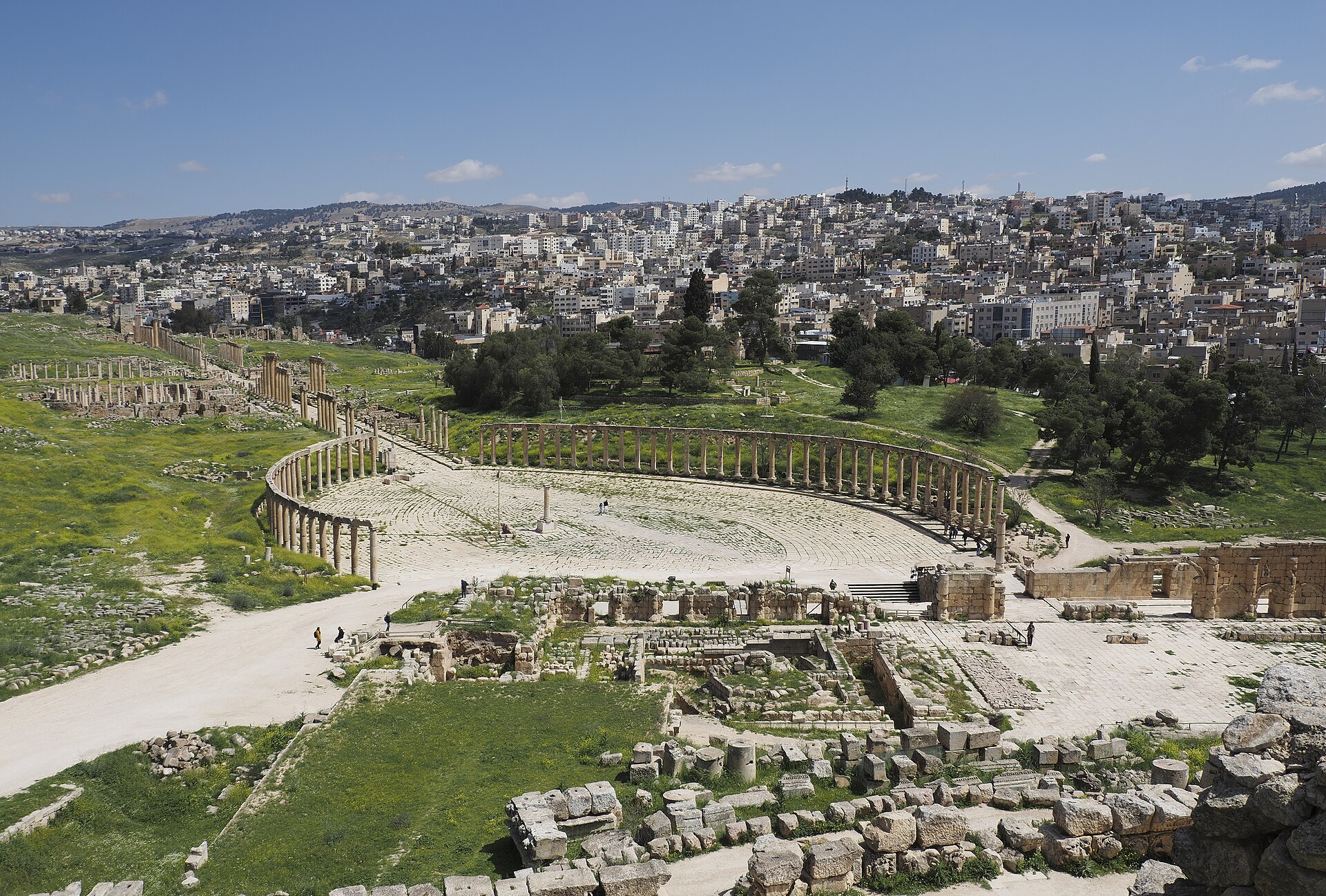
Builders laid out a long main street lined with columns, called the Cardo. They built a huge oval plaza, two theaters, temples to Zeus and Artemis, public baths and fountains. When Emperor Hadrian visited in 129 to 130 CE, the people built a giant arch to welcome him.
Later, Jerash became a Christian city with many churches decorated with mosaics. In 749 CE a strong earthquake shook the region and wrecked much of the city. Over time it was covered by sand and soil.
How it ended
Jerash got smaller after its trade declined, and the earthquake of 749 CE destroyed much of what was left. Sand and soil buried the ruins, which protected them until archaeologists dug them out.
What life was like
Jerash's streets were full of shops selling food, cloth and pottery. People gathered at the oval plaza, worshiped at temples, and watched plays at the South Theatre, which held about 3,000 people. A public fountain called the Nymphaeum gave people fresh water. Farmers grew grain and olives in the green valley.
Wow facts
- Chariot wheel ruts are still visible in the paving stones of the main street.
- Hadrian's Arch was built to welcome an emperor's visit.
- In the South Theatre, a voice at the center of the stage echoes loudly.
Photos
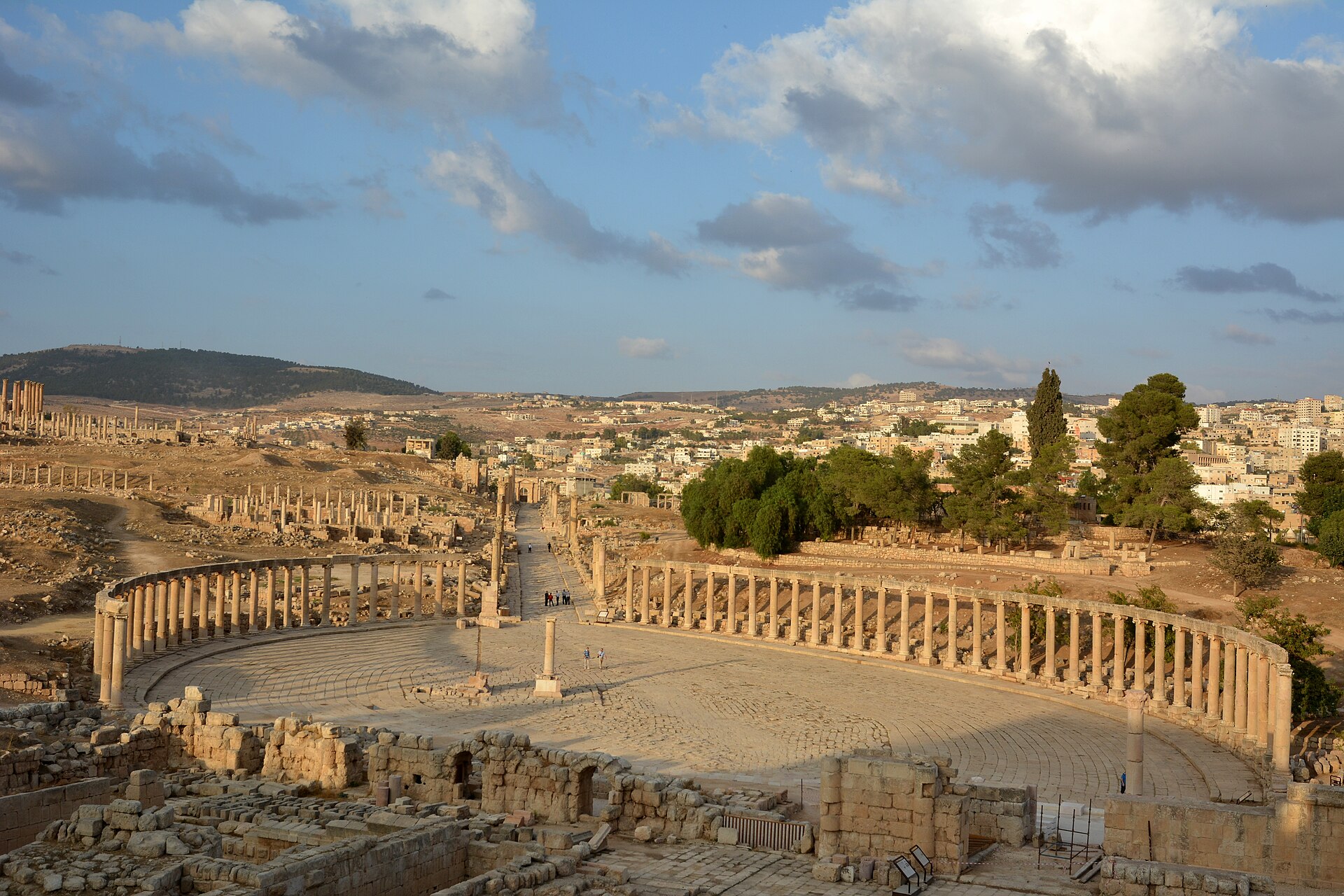 The Oval Forum in Jerash, and the Cardo Maximus Azurfrog, CC BY-SA 3.0
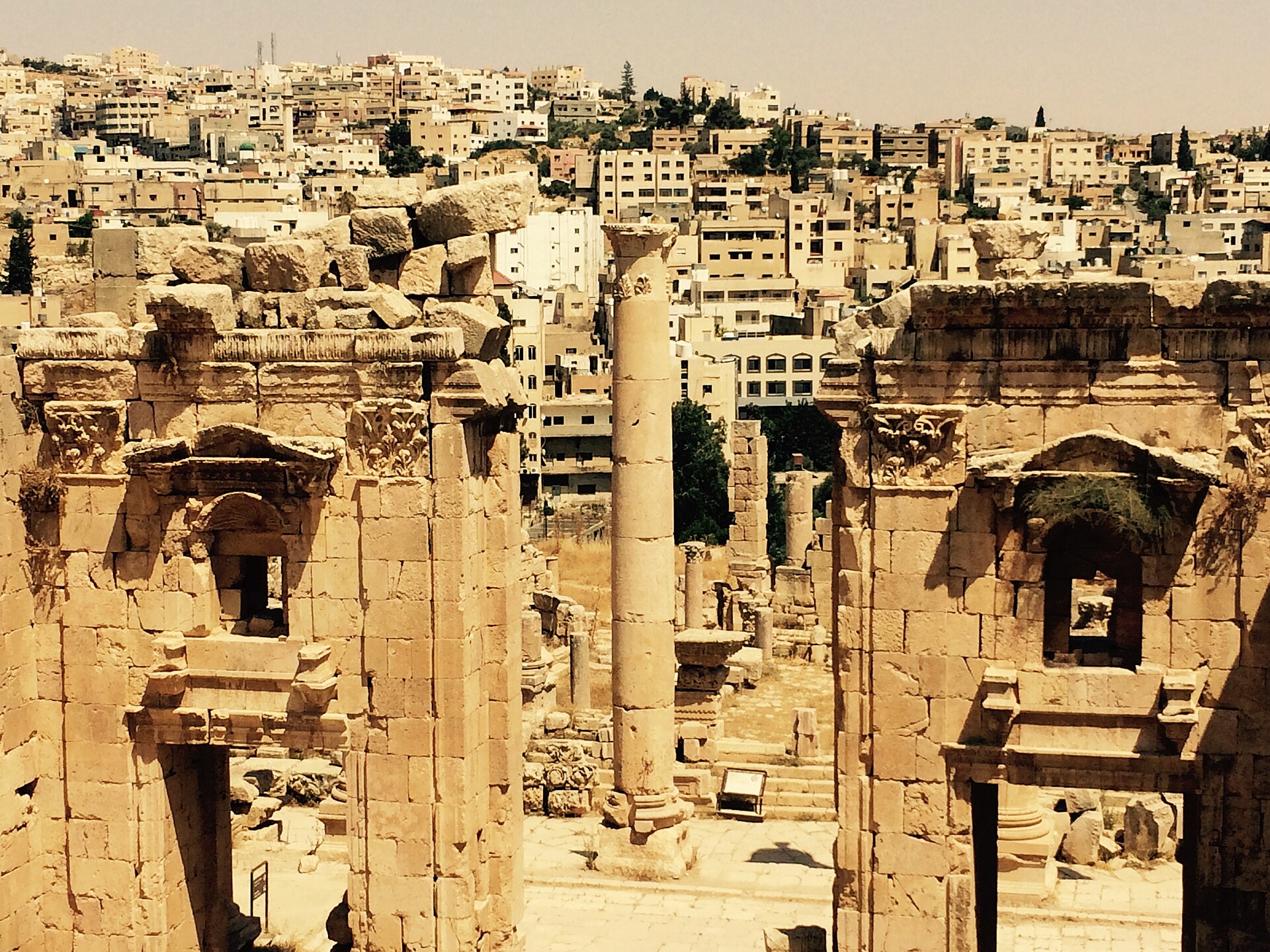 Ancient Jerash against the modern city ZaBanker, CC BY-SA 4.0
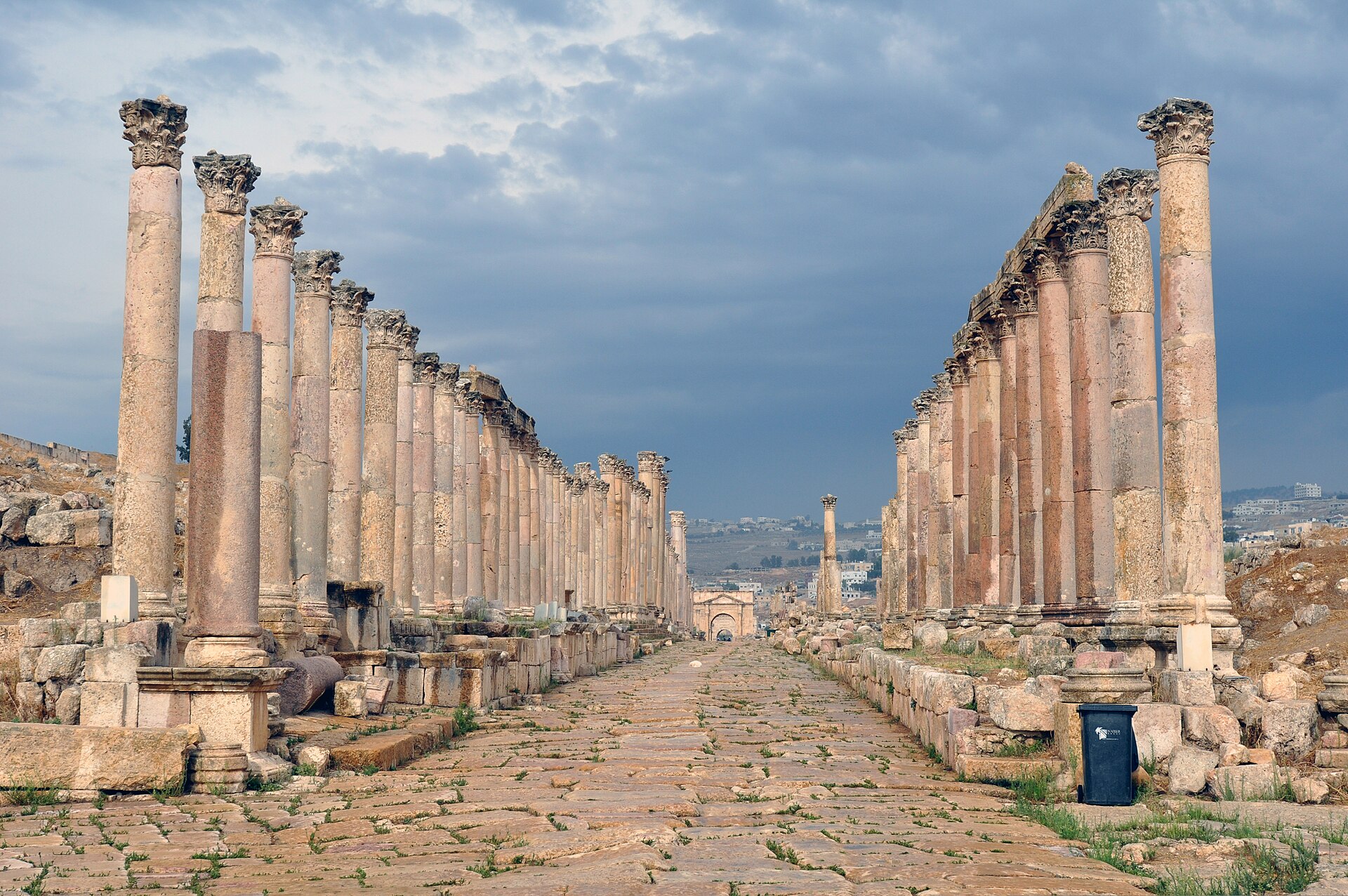 Colonnaded street in the ancient city of Jerash in the Hashemite Kingdom of Jordan, Oct.... Jim Greenhill, U.S. Army, Public domain
Relics and treasures
- Hadrian's Archa triumphal arch built for the emperor's visit, still standing at the site
- Oval Plazaa huge plaza surrounded by columns, at the site
- Temple of Artemistall columns of the city's main temple, at the site
- Church mosaicsfloors showing animals, cities and people, at the site and in the Jordan Archaeological Museum
How we know
Swiss explorer Johann Ludwig Burckhardt described Jerash in 1806. Excavations began in the 1920s and continue with Jordanian and international teams. Inscriptions in Greek and Latin record buildings and dates.
What you would see today
Visitors walk the colonnaded street, stand in the oval plaza, and watch performances in the ancient theaters. Reenactors sometimes show chariot races in the hippodrome. Modern Jerash is a busy town right next to the ruins.
For teachers and classrooms
Suggested level: grades 3-5. Print this page as a lesson sheet with the story, vocabulary, discussion questions and a quiz with an answer key.
Key words
- colonnade
- a long row of columns
- Decapolis
- a group of ten cities in the Roman Near East
- hippodrome
- a stadium for horse and chariot racing
Talk about it
- What clues on a street could tell you how people traveled long ago?
- Why might people welcome an emperor with a giant arch?
Try this activity
- Draw a map of Jerash as it looked at its busiest, and label three things people did there.
- Find Jerash on the Ruinscape timeline, then pick another place from the same century and compare them.
- Use one link in Sources below to find a real object from this place. Describe what it is made of and what it tells us.
Quick quiz
In which country is Jerash?
- Jordan
- Greece
- Spain
- Egypt
Show the answer
A. Jerash is in northern Jordan.
Which emperor's visit was honored with an arch?
- Hadrian
- Nero
- Trajan
- Caligula
Show the answer
A. Hadrian's Arch was built for his visit around 130 CE.
What destroyed much of Jerash in 749 CE?
- A volcano
- An earthquake
- A tsunami
- A blizzard
Show the answer
B. A strong earthquake shook the region in 749 CE.
Sources and further reading
Ruinscape lessons are written for students and checked against encyclopedia and museum records. Go to the sources: these links search real museum collections, the UNESCO list and research by archaeologists.
- Wikipedia articleEncyclopedia overview with its own references
- UNESCO World HeritageOfficial listing, if the site is protected
- Google Arts & CultureMuseum exhibits, virtual tours and close-up photos
- British Museum collectionReal objects, photos and catalog notes
- The Met collectionObjects and essays from the Metropolitan Museum of Art
- Smithsonian collectionsU.S. national museum records
- 3D models on SketchfabScans of sites and artifacts (check each license)
- Scholarly articlesResearch papers by archaeologists and historians
Read the full background
Jerash or Jarash (Arabic: جرش, romanized: Ǧaraš [dʒaraʃ]; Greek: Γέρασα, romanized: Gérasa, Koine Greek pronunciation: [ˈɡerasa]) is a city in northern Jordan. The city is the administrative center of the Jerash Governorate, and has a population of 50,745 as of 2015. It is located 30.0 miles (48.3 kms) north of the capital city Amman.
The earliest evidence of settlement in Jerash is in a Neolithic site known as Tal Abu Sowan, where rare human remains dating to around 7500 BC were uncovered. Jerash flourished during the Hellenistic, Roman, and Byzantine periods, when it was known as Gerasa. It was one of the cities of the Hellenistic cities of the Decapolis. It was an important city in early Christian times and its early churches, some of which were formerly temples, include notable examples of the evolution of church architecture. In the mid-eighth century the 749 Galilee earthquake destroyed large parts of it, and subsequent earthquakes contributed to additional destruction.
In 1120, Zahir ad-Din Toghtekin, atabeg of Damascus ordered a garrison of forty men to build up a fort in an unknown site of the ruins of the ancient city, likely the highest spot of the city walls in the north-eastern hills. It was captured in 1121 by Baldwin II, King of Jerusalem, and utterly destroyed. The Crusaders immediately abandoned Jerash and withdrew to Sakib (Seecip); the eastern border of the settlement.
Jerash was then deserted and reappeared in the historical record at the beginning of Ottoman rule in the area during the early 16th century. In the census of 1596, it had a population of 12 Muslim households. However, archaeologists found a small Mamluk hamlet in the Northwest Quarter which indicates that Jerash was resettled before the Ottoman era. The excavations conducted since 2011 have shed light on the Middle Islamic period as recent discoveries have uncovered a large concentration of Middle Islamic/Mamluk structures and pottery. The ancient city has been gradually revealed through a series of excavations since 1925.
Jerash today is home to one of the best preserved Greco-Roman cities, which earned it the nickname "Pompeii of the Middle East".
In 2025, the findings of a mass grave excavated in Jerash attest archaeologically and genetically to the presence of the Plague of Justinian in this region of the world.
Approximately 330,000 visitors arrived in Jerash in 2018,
Background text from Wikipedia, available under CC BY-SA 4.0.
Last updated: October 2026. How we make Ruinscape.