The story
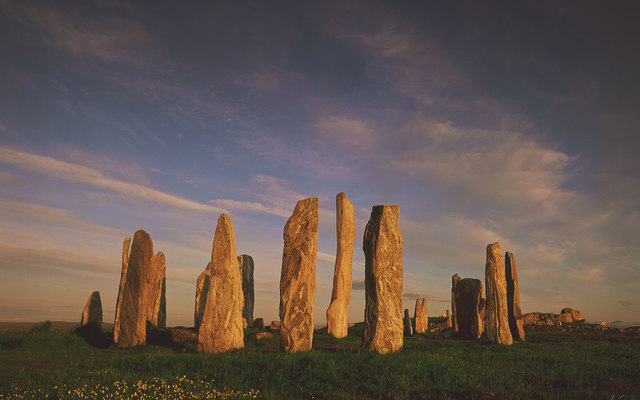
About 5,000 years ago, around 2900 BCE, Neolithic farmers raised the Callanish Stones. The center is a ring of 13 tall stones around a single giant stone almost 5 meters tall. Rows of stones lead away to the north, south, east and west.
Later, a small chambered tomb was built inside the ring. Many people think the stones were connected to the moon. Every 18.6 years, the moon rises very low over the hills to the south and seems to move along the ridge, a rare event the builders may have watched.
Over the centuries, peat, a thick soggy soil, grew around the stones and buried their bottoms. In 1857 the peat was dug away, and people could see how tall they really were.
How it ended
The people who built Callanish changed their ways over time and stopped using the site, perhaps around 1500 to 1000 BCE. Peat slowly covered the stones until it was cleared in 1857.
What life was like
The builders were farmers who raised cattle and sheep and grew barley on the island. They used local gneiss, one of the oldest kinds of rock on Earth. Raising the stones took planning and teamwork, with ropes, levers and wooden frames. Gatherings at the stones may have marked the seasons or honored the dead.
Wow facts
- The stones are made of Lewisian gneiss, rock about 3 billion years old.
- Peat buried the stones about 1.5 meters deep until 1857.
- Local legend says the stones were giants turned to stone.
Photos
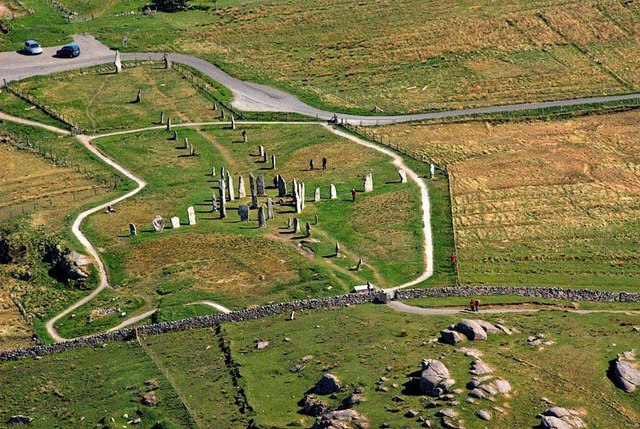 Calanais Stones Aerial view of the Calanais Stones, supposedly older than Stonehenge. Stephen Branley, CC BY-SA 2.0
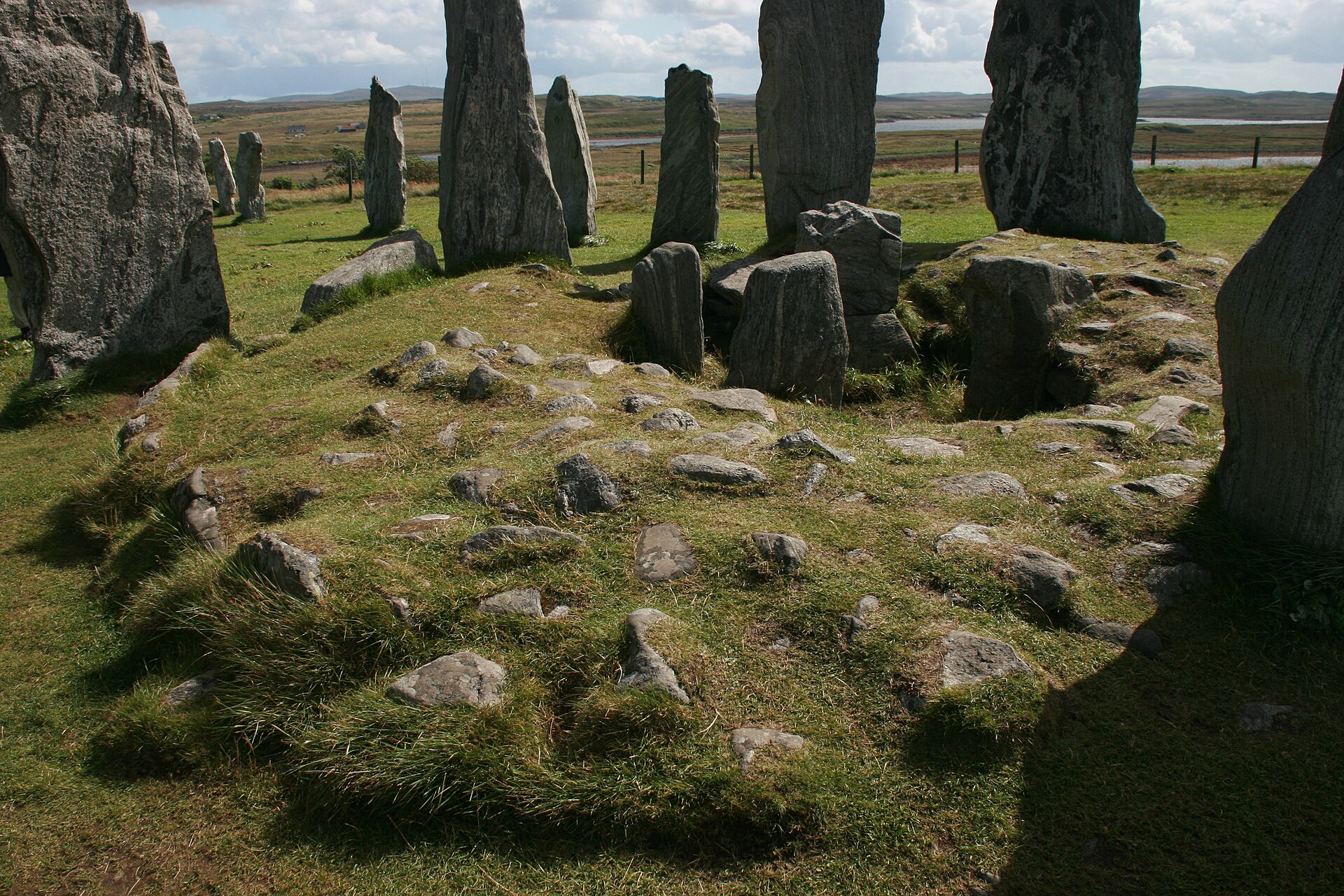 Piedras de Callanish en el verano de 2011. Erigidas en el Neolítico, están consideradas... Nachosan, CC BY-SA 3.0
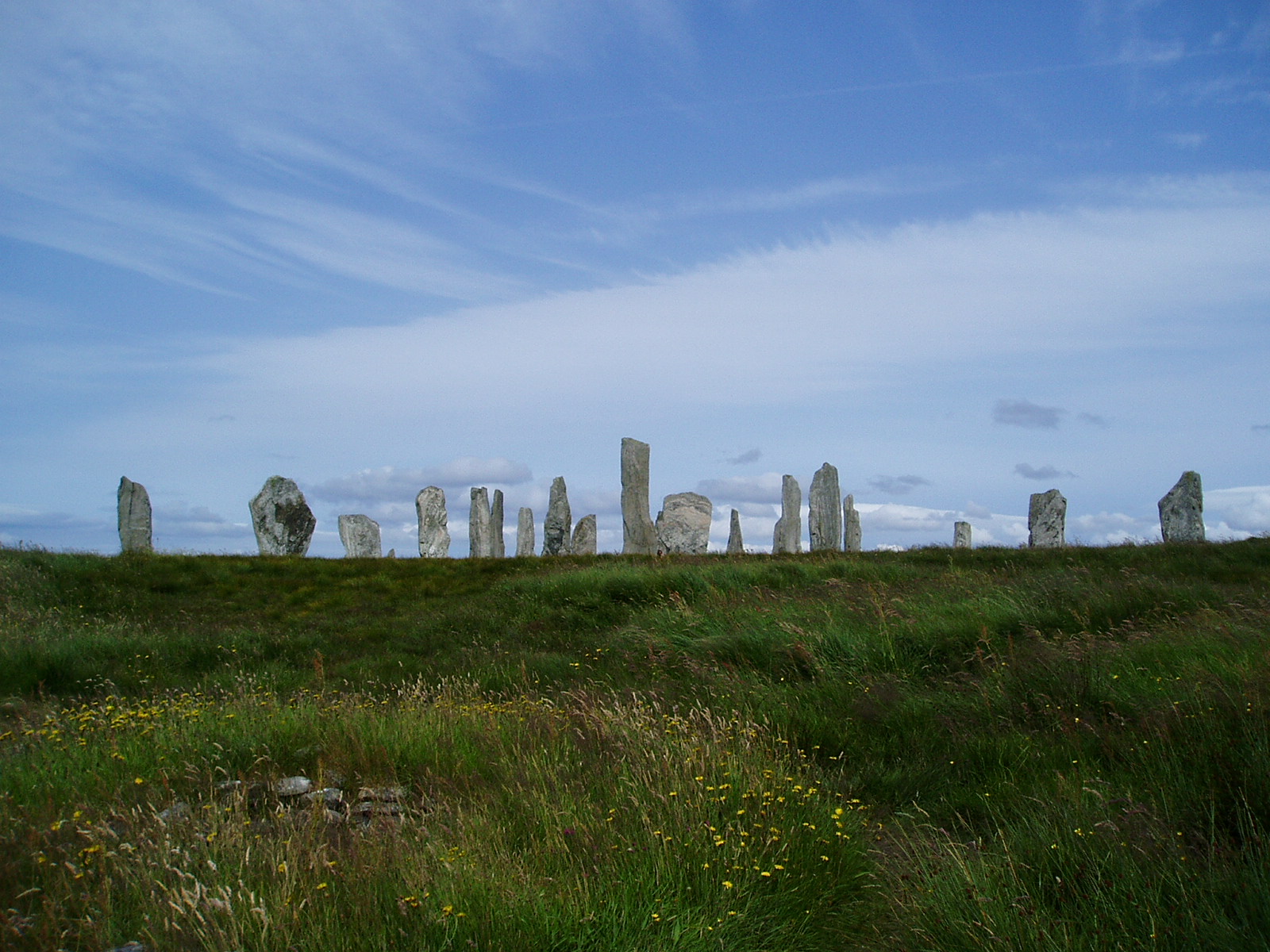 The standing stones of Callanish on the Isle of Lewis, Scotland. Original uploader was Netvor at en.wikipedia, CC BY-SA 3.0
Relics and treasures
- The main circle13 stones around a tall central stone, at the site
- Stone avenuethe long double row leading north, at the site
- Chambered tomba small burial chamber inside the ring, at the site
- Nearby circlessmaller stone circles around Callanish
How we know
Excavations in 1980 and 1981 found pottery and dated the site. Studies of the peat show when it built up. Astronomers have tested how the stones line up with the moon.
What you would see today
Visitors walk freely among the stones, which are open all year. A visitor center explains their history. Several smaller stone circles are nearby, and people gather here to watch the special low moon.
For teachers and classrooms
Suggested level: grades 3-5. Print this page as a lesson sheet with the story, vocabulary, discussion questions and a quiz with an answer key.
Key words
- peat
- thick, wet soil made from dead plants, found in bogs
- gneiss
- a hard, banded type of rock formed deep in the Earth
- alignment
- the way things are lined up in a row or direction
Talk about it
- Why might people build something to track the moon?
- How could peat help protect the stones?
Try this activity
- Draw a map of Callanish Stones as it looked at its busiest, and label three things people did there.
- Find Callanish Stones on the Ruinscape timeline, then pick another place from the same century and compare them.
- Use one link in Sources below to find a real object from this place. Describe what it is made of and what it tells us.
Quick quiz
What shape do the Callanish Stones make from above?
- A cross
- A triangle
- A star
- A spiral
Show the answer
A. Rows of stones stretch out from the circle like a cross.
What buried the stones' bottoms for centuries?
- Peat
- Sand
- Snow
- Lava
Show the answer
A. Peat grew about 1.5 meters deep until 1857.
Which sky event may the stones be linked to?
- A rare low moon
- A comet
- A rainbow
- Northern lights only
Show the answer
A. Every 18.6 years the moon skims low over the southern hills.
Sources and further reading
Ruinscape lessons are written for students and checked against encyclopedia and museum records. Go to the sources: these links search real museum collections, the UNESCO list and research by archaeologists.
- Wikipedia articleEncyclopedia overview with its own references
- UNESCO World HeritageOfficial listing, if the site is protected
- Google Arts & CultureMuseum exhibits, virtual tours and close-up photos
- British Museum collectionReal objects, photos and catalog notes
- The Met collectionObjects and essays from the Metropolitan Museum of Art
- Smithsonian collectionsU.S. national museum records
- 3D models on SketchfabScans of sites and artifacts (check each license)
- Scholarly articlesResearch papers by archaeologists and historians
Read the full background
The Calanais Stones (also known as Calanais I; Scottish Gaelic: Clachan Chalanais or Tursachan Chalanais) are a prehistoric stone circle and stone alignment on the west coast of the Isle of Lewis in the Outer Hebrides of Scotland. The monument was built during the Neolithic period, around c. 2750 BC.
The stones form a circle with a tall central monolith and several rows of standing stones extending outward in different directions, creating a distinctive cross-shaped layout. The monument stands on a low ridge overlooking Loch Roag, near the village of Calanais.
The Calanais Stones are the central site within a wider landscape of prehistoric monuments on Lewis. Several other stone circles and settings lie nearby, including Callanish II, Callanish III, Callanish IV, and Callanish VIII, forming what archaeologists often describe as the Calanais complex.
Archaeological evidence shows that the site was used for ceremonial activity for many centuries during the Neolithic and Bronze Age. Today, the stones are among the most important prehistoric monuments in Britain and are protected as a scheduled monument in the care of Historic Environment Scotland.
Background text from Wikipedia, available under CC BY-SA 4.0.
Last updated: October 2026. How we make Ruinscape.