The story
Nimrud, called Kalhu by the Assyrians, became the capital of the Assyrian Empire when King Ashurnasirpal II rebuilt it around 879 BCE. He threw a famous party to celebrate, and a carved stone says nearly 70,000 guests came for ten days.
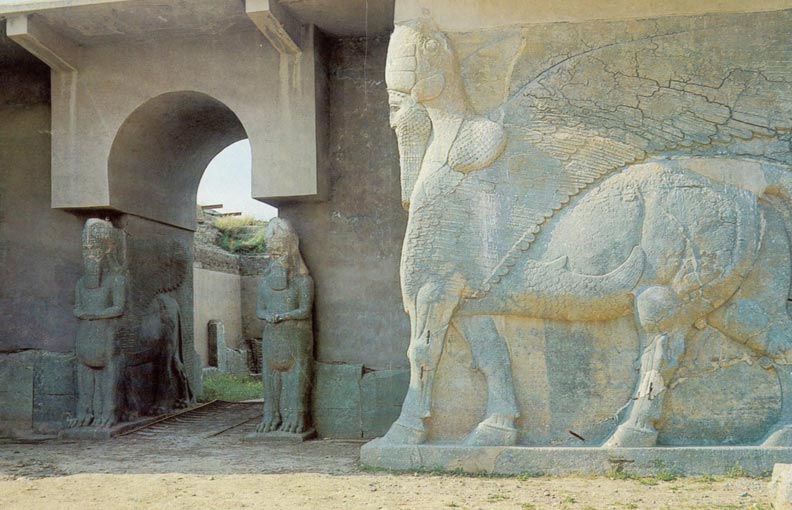
The palace walls were lined with carved stone panels showing kings hunting lions, fighting battles and meeting gods. At the doorways stood lamassu, huge winged bulls or lions with human heads, meant to protect the king.
In 1988 and 1989, Iraqi archaeologists found tombs of Assyrian queens beneath the palace floor, full of gold crowns, earrings and bracelets. Nimrud was destroyed in 612 BCE, when the Assyrian Empire fell to the Babylonians and Medes.
How it ended
In 612 BCE, the Babylonians and Medes attacked Assyria and burned its cities, including Nimrud. The mound sat quietly for over 2,000 years. In 2015 it was badly damaged on purpose, which made protecting heritage a worldwide concern.
What life was like
Nimrud's palaces were busy with officials, scribes, soldiers and servants. Scribes wrote in cuneiform on clay tablets. Craftsmen carved ivory into furniture decorations. The king brought in plants and animals from distant lands for his gardens and zoo. Farmers along the Tigris grew barley and raised sheep.
Wow facts
- Thousands of carved ivory pieces were found at Nimrud, some dropped into a well.
- A stone stela records a 10-day feast for about 70,000 guests.
- The Assyrian queens' tomb gold weighed more than 50 kilograms.
Photos
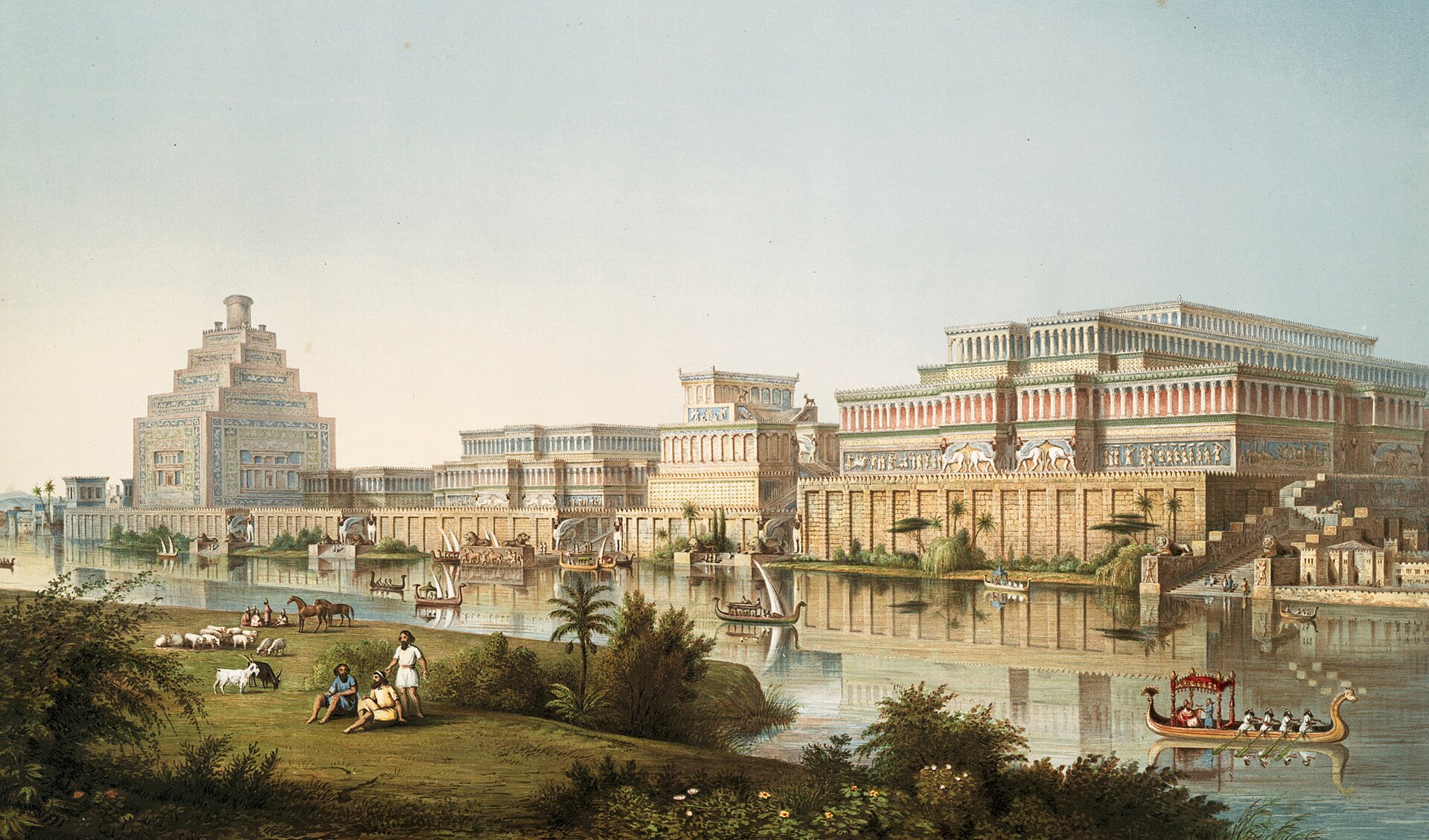 Artist's impression of Assyrian palaces, from a sketch by James Fergusson (1808–1886)... Austen Henry Layard, Public domain
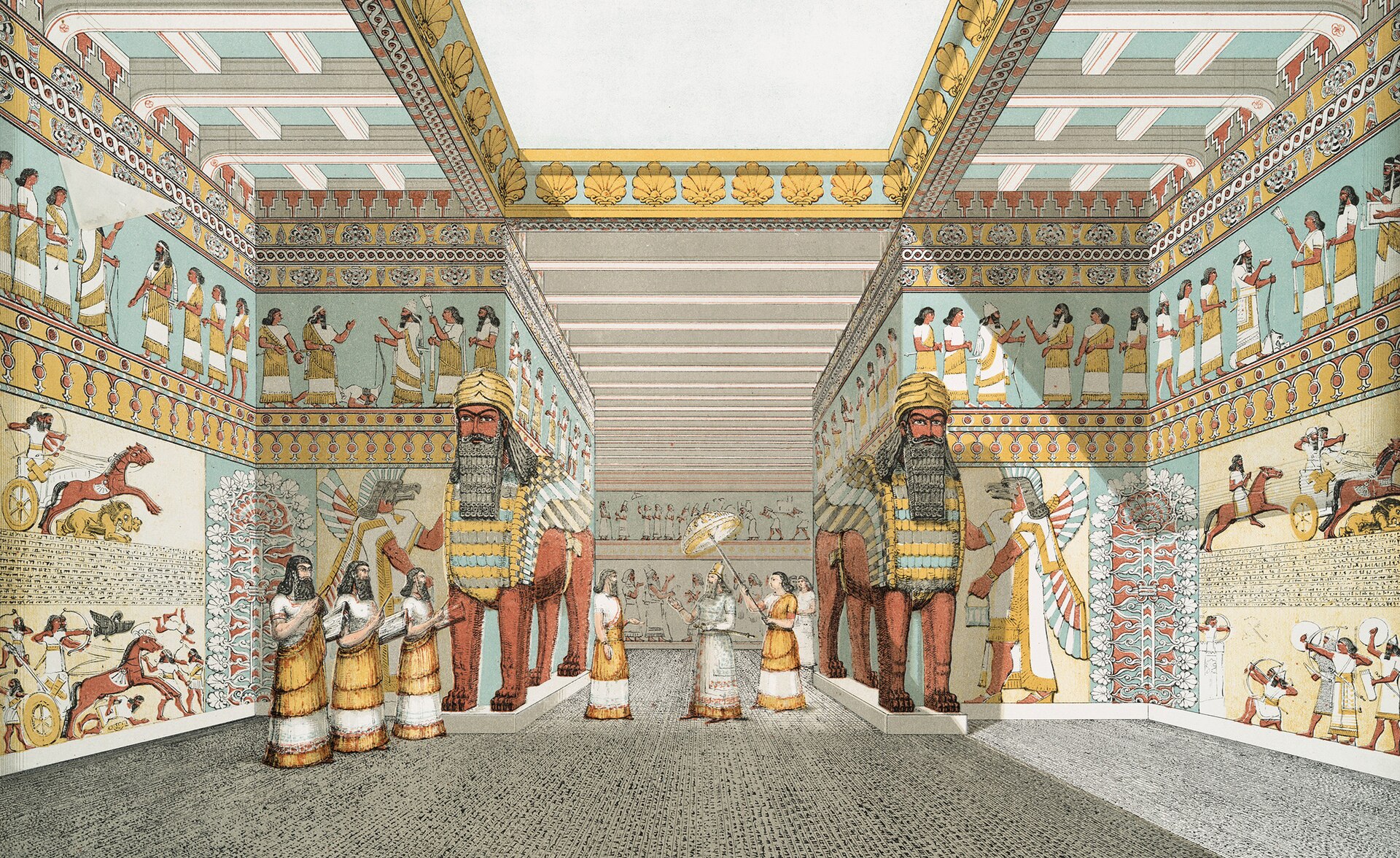 Hall in an Assyrian Temple or Palace, restored from actual remains, and from fragments... Sir Austen Henry Layard, 1853, Public domain
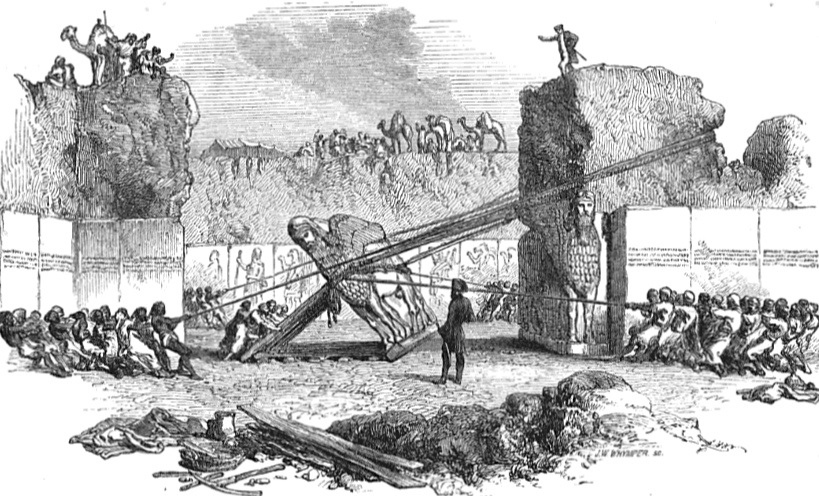 Frontispiece, A popular account of discoveries at Nineveh. Austen Henry Layard; in... onceinawhile, Public domain
Relics and treasures
- Lamassuwinged guardian figures from the palace gates, in the British Museum and the Metropolitan Museum of Art
- Nimrud ivoriescarved ivory furniture pieces, in the Iraq Museum and the British Museum
- Treasure of the Nimrud queensgold jewelry from royal tombs, in the Iraq Museum in Baghdad
- Banquet stela of Ashurnasirpal IIa stone telling of his great feast, in the Mosul Museum
How we know
Austen Henry Layard dug at Nimrud in the 1840s and sent carvings to London. Max Mallowan found ivories in the 1950s, and Iraqi archaeologist Muzahim Mahmoud found the queens' tombs in 1988. Cuneiform tablets and inscriptions tell the kings' stories.
What you would see today
Many of Nimrud's carvings are in museums around the world. In 2015, the militant group ISIS deliberately blew up and bulldozed much of the site. Iraqi and international teams have since been documenting and protecting what remains.
For teachers and classrooms
Suggested level: grades 6-8. Print this page as a lesson sheet with the story, vocabulary, discussion questions and a quiz with an answer key.
Key words
- lamassu
- an Assyrian guardian figure with a bull or lion body, wings and a human head
- cuneiform
- wedge-shaped writing pressed into clay
- heritage
- things from the past that people value and protect
Talk about it
- Why do you think some groups destroy ancient sites, and why is that a loss for everyone?
- What can museums do to protect heritage from war?
Try this activity
- Draw a map of Nimrud as it looked at its busiest, and label three things people did there.
- Find Nimrud on the Ruinscape timeline, then pick another place from the same century and compare them.
- Use one link in Sources below to find a real object from this place. Describe what it is made of and what it tells us.
Quick quiz
What is a lamassu?
- A winged guardian with a human head
- A type of chariot
- A clay tablet
- A river boat
Show the answer
A. Lamassu guarded Assyrian palace gates.
Which empire made Nimrud its capital?
- Roman
- Assyrian
- Inca
- Egyptian
Show the answer
B. Nimrud was a capital of the Assyrian Empire.
What was found under the palace floor in 1988?
- A river
- Royal tombs full of gold
- A dinosaur
- A library of books
Show the answer
B. Tombs of Assyrian queens held gold jewelry.
Sources and further reading
Ruinscape lessons are written for students and checked against encyclopedia and museum records. Go to the sources: these links search real museum collections, the UNESCO list and research by archaeologists.
- Wikipedia articleEncyclopedia overview with its own references
- UNESCO World HeritageOfficial listing, if the site is protected
- Google Arts & CultureMuseum exhibits, virtual tours and close-up photos
- British Museum collectionReal objects, photos and catalog notes
- The Met collectionObjects and essays from the Metropolitan Museum of Art
- Smithsonian collectionsU.S. national museum records
- 3D models on SketchfabScans of sites and artifacts (check each license)
- Scholarly articlesResearch papers by archaeologists and historians
Read the full background
Nimrud (; Syriac: ܢܢܡܪܕ Arabic: النمرود) is an ancient Assyrian city (original Assyrian name Kalḫu, biblical name Calah) located in Iraq, 30 kilometres (20 mi) south of the city of Mosul, and 5 kilometres (3 mi) south of the village of Selamiyah (Arabic: السلامية), in the Nineveh Plains in Upper Mesopotamia. It was a major Assyrian city between approximately 1350 BC and 610 BC. The city is located in a strategic position 10 kilometres (6 mi) north of where the river Tigris meets its tributary the Great Zab. The city covered an area of 360 hectares (890 acres). The ruins of the city were found within one kilometre (1,100 yd) of the modern-day Assyrian village of Noomanea in Nineveh Governorate, Iraq.
By 800 BCE, the city of Nimrud had expanded to a population of approximately 75,000, establishing it as the most populous urban center in the world at that time.
The name Nimrud was recorded as the local name by Carsten Niebuhr in the mid-18th century. In the mid 19th century, biblical archaeologists proposed the Assyrian name Kalḫu (the Biblical Calah), based on a description of the travels of Nimrod in Genesis 10.
Archaeological excavations at the site began in 1845, and were conducted at intervals between then and 1879, and then from 1949 onwards. Many important pieces were discovered, with most being moved to museums in Iraq and abroad. In 2013, the UK's Arts and Humanities Research Council funded the "Nimrud Project", directed by Eleanor Robson, whose aims were to write the history of the city in ancient and modern times, to identify and record the dispersal history of artefacts from Nimrud, distributed amongst at least 76 museums worldwide (including 36 in the United States and 13 in the United Kingdom).
In 2015, the terrorist organization Islamic State announced its intention to destroy the site because of its "un-Islamic" Assyrian nature. In March 2015, the Iraqi government reported that Islamic State had used bulldozers to destroy excavated remains of the city. Several videos released by ISIL showed the work in progress. In November 2016, Iraqi forces retook the site, and later visitors also confirmed that around 90% of the excavated portion of city had been completely destroyed. The ruins of Nimrud have remained guarded by Iraqi forces ever since. Reconstruction work is in progress.
Background text from Wikipedia, available under CC BY-SA 4.0.
Last updated: October 2026. How we make Ruinscape.