No. 182
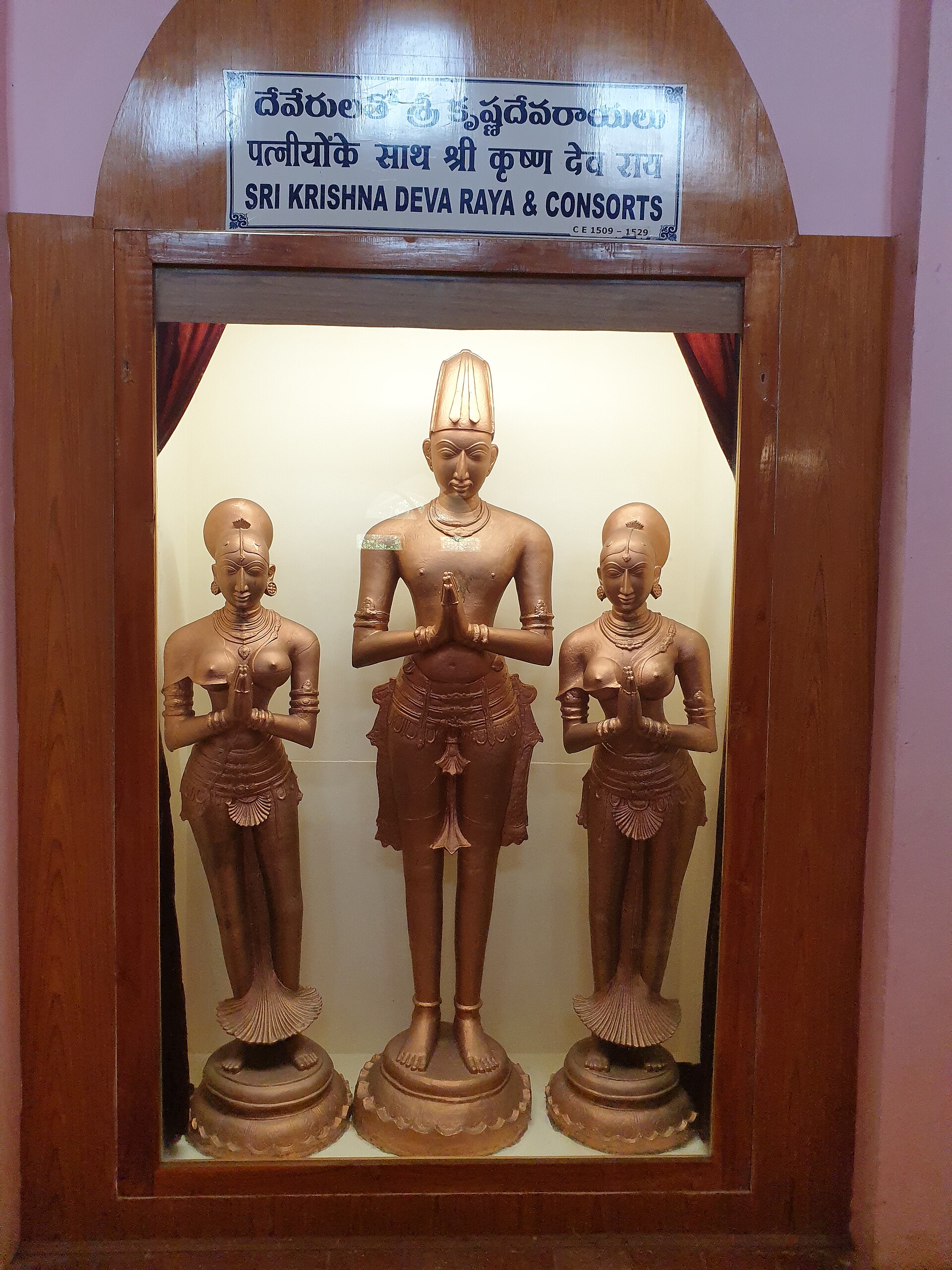
Krishnadevaraya

- Where
- Vijayanagara
- Culture
- Vijayanagara
- Lived
- reigned 1509-1529
- Why they matter
- Ruled Hampi at its peak.
- Fate
- His capital was sacked 36 years after his death.

Lyra Kael can take you here on the globe, tell you the story out loud and answer your questions. Start the time jump.
Background
Krishnadevaraya (17 January 1471 – 17 October 1529) was emperor of the Vijayanagara Empire from 1509 to 1529 and the third ruler of the Tuluva dynasty. Widely regarded as one of the greatest rulers in Indian history, he presided over the empire at its political and cultural zenith and is remembered as an iconic figure by many Indians. Following the decline of the Delhi Sultanate, he ruled the largest and most powerful empire in India during his time.
Krishnadevaraya's reign was marked by military expansion and political consolidation. He became the dominant ruler of the Indian peninsula by defeating the sultans of Bijapur, Golconda, the Bahmani Sultanate, and the Gajapatis of Odisha, making him one of the most powerful Hindu monarchs in Indian history. Major campaigns during his reign included the conquest of the Raichur Doab in 1512, the subjugation of Odisha in 1514, and a decisive victory against the Sultan of Bijapur in 1520. On many occasions, the king changed battle plans abruptly, turning a losing battle into victory.
When the Mughal emperor Babur surveyed the rulers of India, he considered Krishnadevaraya the most powerful, ruling over the most extensive empire in the subcontinent. Portuguese travellers Domingo Paes and Duarte Barbosa, who visited his court, described him as an able administrator and an exceptional military commander who personally led campaigns and tended to wounded soldiers. The poet Mukku Timmana praised him as the "Destroyer of the Turks". Krishnadevaraya was guided by his trusted prime minister Timmarusu, whom he credited as the architect of his rise to the throne, and was also advised by the witty poet Tenali Ramakrishna.
His reign is also regarded as a golden age of Telugu literature, and he was a distinguished patron of arts and scholarship. Krishnadevaraya himself composed the Telugu poetic work Amuktamalyada, celebrated for its literary and devotional value. His court was home to the Ashtadiggajas—eight legendary Telugu poets—including Allasani Peddana and Mukku Timmana. Literary activity flourished not only in Telugu but also in Sanskrit, Kannada, and Tamil under his patronage, making his court a major cultural hub of the era.
Krishnadevaraya was conferred with several honorific titles such as Andhra Bhoja ("Bhoja of Andhra"), Karnatakaratna Simhasanadeeshwara ("Lord of the Jewelled Throne of Karnataka"), Mooru Rayara Gand
Text from Wikipedia, licensed CC BY-SA 4.0.